
Between 18 and 24 April 2026, Ghana’s STEM ecosystem delivered some of its most people centred and forward looking developments. This week’s roundup of Ghana STEM news April 2026 highlights policy breakthroughs, cuttingedge research, homegrown innovation and publichealth science—all explained clearly for nonexperts.
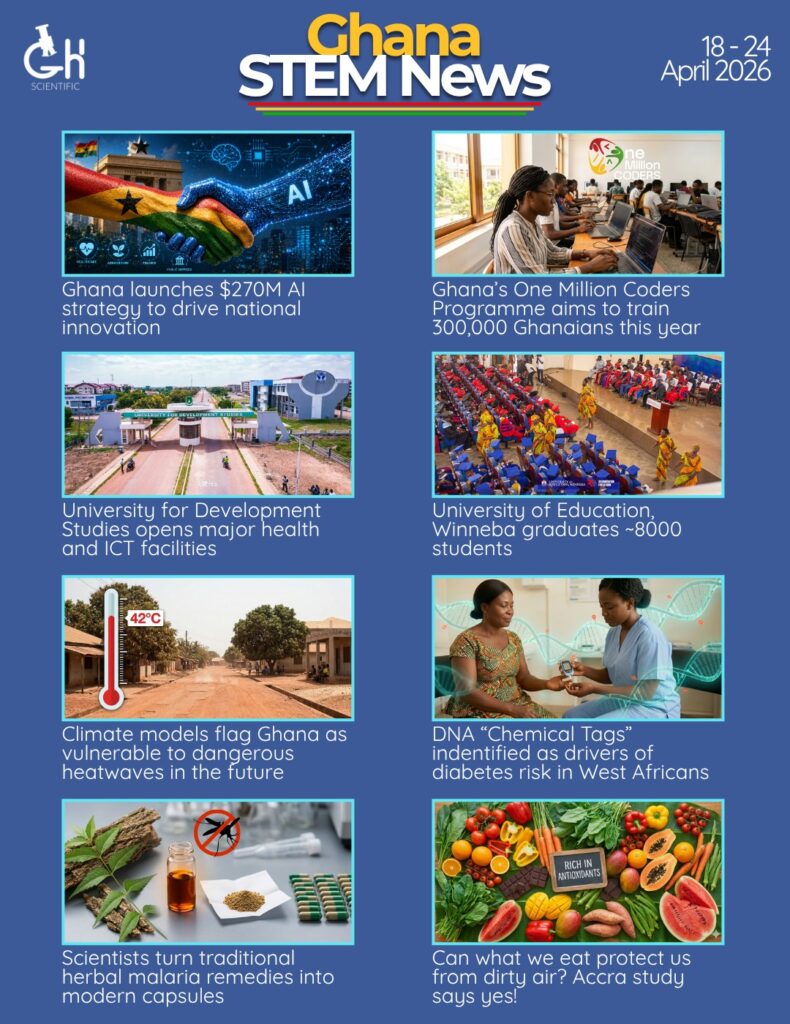
1. Ghana Launches $270 Million National Artificial Intelligence Strategy
Source: Graphic Online (24 April 2026) [ghanapolit…online.com]
What happened
President John Dramani Mahama launched Ghana’s National AI Strategy, backed by a $270 million investment, including a $250 million National AI Computing Centre.
Why it matters
AI will affect healthcare, farming, finance and public services. This move ensures Ghana builds its own AI solutions, using Ghanaian data, languages and priorities—marking a major leap in Ghana STEM news April 2026.
2. One Million Coders Programme to Train 300,000 Ghanaians This Year
Source: MyJoyOnline (24 April 2026)[gstep.org.gh]
What happened
Government announced that 300,000 people will receive training in coding, AI and digital skills in 2026 under the One Million Coders Programme, with nationwide learning centres already active.
Why it matters
Big technology investments only succeed when people have skills. This programme tackles youth unemployment, digital exclusion and futureproof jobs, making it one of the most impactful Ghana STEM news April 2026 stories.
3. University for Development Studies Opens Major Health and ICT Facilities
Source: GBC Ghana Online (24 April 2026) [ghscientific.com]
What happened
UDS inaugurated new health sciences labs, ICT centres and a dental clinic to strengthen teaching and research.
Why it matters
Strong infrastructure means bettertrained health workers, improved research and stronger healthcare delivery, especially in underserved regions.
4. Can What We Eat Protect Us From Dirty Air? Accra Study Says YesSource: Environmental Epidemiology (15 April 2026)
What happened
A research team led by Dr. Adeladza Amega from the University of Cape Coast studying street vendors in Accra found that regular consumption of antioxidantrich foods reduced cough, breathing problems, heart symptoms and hospital visits among people heavily exposed to air pollution.
Why it matters
Air pollution cannot always be avoided—but diet can reduce its health impact. This shows how everyday food choices can support public health when environmental risks remain high.
5. Scientists Turn Traditional Herbal Malaria Remedies Into Modern CapsulesSource: Journal of Tropical Medicine (20 April 2026)
What happened
Researchers successfully converted popular malaria herbal decoctions—Azadirachta indica (neem) and Khaya senegalensis—into stable, measured capsules with proven antimalarial activity. The lead author on this study was Dr. Winifred Adoley at KNUST
Why it matters
This bridges indigenous knowledge and pharmaceutical science, improving safety, dosage consistency and acceptability of traditional medicine.
6. DNA “Chemical Tags” Identified as Drivers of Diabetes Risk in West Africans
Source: Diabetologia (24 April 2026)
What happened
A team of researchers from Ghana, USA and Netherlands analysing Ghanaian and Nigerian data identified two epigenetic markers that play a causal role in type 2 diabetes, using advanced genetic methods.
Why it matters
Diabetes is rising in Ghana. This study shows disease risk is linked not just to genes, but to modifiable lifestylelinked biological changes, opening doors to earlier diagnosis and better prevention.
7. Ghana Faces Escalating Heat Risk as Climate Models Flag Dangerous Future
Source: NewsGhana (23 April 2026)
What happened
New climate modelling research has identified Ghana as one of the West African countries most vulnerable to dangerous heatwaves over the coming decades. The findings, based on multiple advanced global climate models and reinforced by a recent United Nationslinked report, show that both the intensity and duration of extreme heat are expected to rise sharply—especially in rural areas.Using a metric called “persondays”—which measures how many people are exposed to dangerous heat and for how long—the research projects that under highemission scenarios, rural heat exposure in West Africa will far exceed that of urban areas. In Ghana, this risk is amplified by widespread reliance on outdoor work, particularly agriculture, and by deforestation, which traps heat and increases humidity.Some projections suggest that by the second half of the century, parts of Africa could experience heatwave conditions for up to 250–300 days per year, with individual heatwaves lasting more than a month.
Why it matters
This story shows that climate change is no longer a distant environmental issue—it is a public health, food security and economic risk that is already taking shape. For Ghana, rising heat threatens:Farm productivity, especially cocoa, maize and cassava; Rural livelihoods, where most work is done outdoors; Human health, including heat stress, dehydration and cardiovascular strainNational productivity, as extreme heat reduces safe working hours. The research also points to practical, sciencebased responses. Protecting and restoring forests, adopting climatesmart and agroforestry farming, improving heat earlywarning systems, and training health workers to recognise heatrelated illness can significantly reduce harm. For lay audiences, the key message is clear: managing heat is as much about local land use and public health planning as it is about global climate policy. What happens on farms, in forests and in rural communities will shape how well Ghana adapts to a hotter future.
8. UEW Graduates Nearly 8,000 Students—Majority Women
Source: Ghana Business News (24 April 2026) [ghstandard.com]
What happened
University of Education, Winneba graduated 7,951 students, 65% women, across education and sciencerelated fields.
Why it matters
STEMliterate educators shape future innovators. Gender balance here strengthens Ghana’s longterm STEM pipeline.