
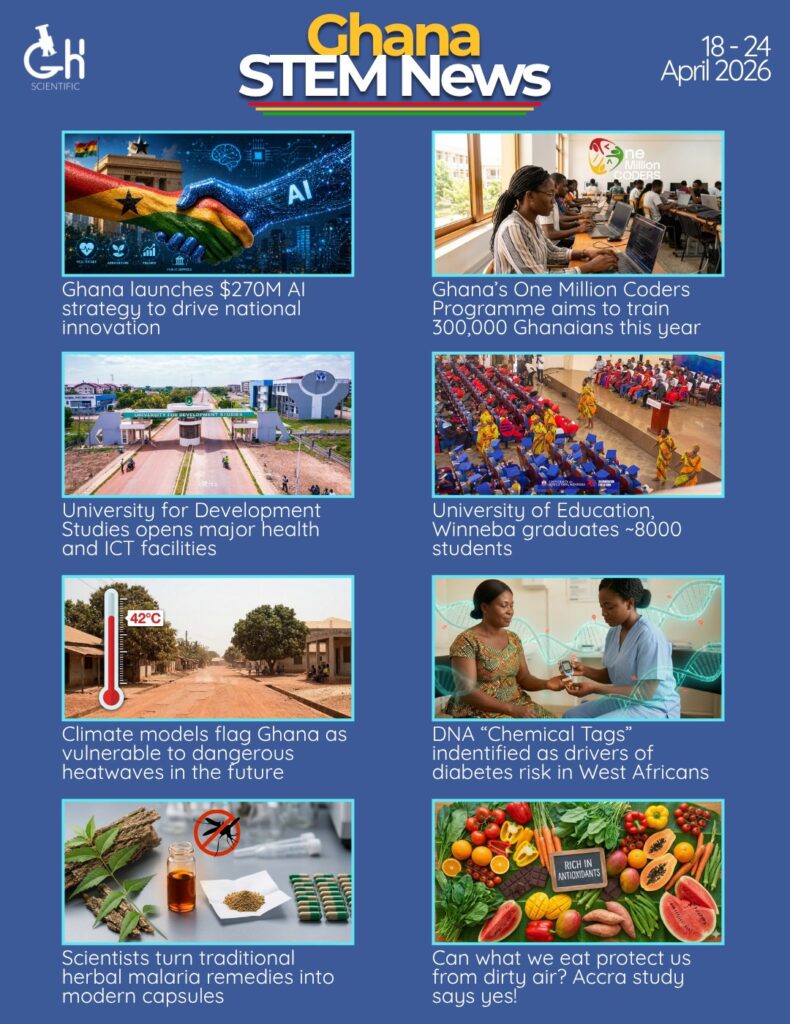
Science, technology, engineering and medicine are not abstract ideas—they shape jobs, health, food, education and daily survival. Between 18 and 24 April 2026, Ghana’s STEM ecosystem delivered some of its most people-centred and forward-looking developments yet. This science-communication roundup of Ghana STEM news April 2026 highlights policy breakthroughs, cutting-edge research, home-grown innovation and public-health.
1. Ghana Launches $270 Million National AI Strategy
Source: Graphic Online
What happened
President John Dramani Mahama launched Ghana’s National AI Strategy, backed by a $270 million investment. This includes $250 million for a National AI Computing Centre and $20 million for implementation.
Why it matters
AI will transform healthcare, farming, finance, and public services. This will help Ghana builds its own AI solutions using local data, priorities and languages, marking a major leap in sovereign technology development.
2. One Million Coders Programme to Train 300,000 Ghanaians
Source: MyJoyOnline
What happened
The government announced that 300,000 people will receive training in coding, AI, and digital skills in 2026 under the One Million Coders Programme. A pilot phase was conducted last year, which helped prepare adequately for a national rollout.
Why it matters
Tech investments require a skilled workforce. This initiative will equip the youth with needed skills to stay relevant and employable, taking care of youth unemployment and digital exclusion.
3. University for Development Studies Opens Major Health and ICT Facilities
Source: GBC Ghana Online
What happened
The University for Development Studies (UDS) inaugurated new health sciences labs, ICT centers, and a dental clinic to strengthen research and teaching.
Why it matters
Stronger infrastructure leads to better-trained healthcare workers and improved medical research, particularly benefiting underserved regions in Ghana.
4. Can What We Eat Protect Us From Dirty Air? Accra Study Says Yes
Source: Environmental Epidemiology
What happened
Led by Dr. Adeladza Amegah, a research team from the University of Cape Coast found that regular consumption of antioxidant-rich foods reduced respiratory and heart symptoms among street vendors in Accra heavily exposed to air pollution.
Why it matters
While pollution is hard to avoid, dietary choices offer a practical way to reduce health risks and support public health in high-exposure environments.
5. Scientists Turn Traditional Herbal Malaria Remedies Into Modern Capsules
Source: Journal of Tropical Medicine
What happened
Led by Dr. Winifred Adoley at KNUST, researchers successfully converted traditional neem (Azadirachta indica) and mahogany (Khaya senegalensis) decoctions into stable, measured pharmaceutical capsules.
Why it matters
This bridges indigenous knowledge with modern science, improving dosage accuracy and patient compliance for traditional antimalarial treatments.
6. DNA “Chemical Tags” Identified as Drivers of Diabetes Risk in West Africans
Source: Diabetologia
What happened
A research team from Ghana, Netherlands and USA identified two epigenetic markers (DNA methylation sites) that play a causal role in type 2 diabetes specifically within Ghanaian and Nigerian populations.
Why it matters
As diabetes rates rise in Ghana, understanding these lifestyle-linked biological changes allows for earlier diagnosis and more personalized prevention strategies.
7. Ghana Faces Escalating Heat Risk as Climate Models Flag Dangerous Future
Source: NewsGhana
What happened
Climate models flag Ghana as highly vulnerable to extreme heatwaves. Projections suggest some areas could face dangerous heat for up to 300 days per year by late century.
Why it matters
Rising heat threatens cocoa and maize productivity, rural livelihoods, and public health. Science-based responses like agroforestry and heat early-warning systems are now critical for national adaptation.
8. UEW Graduates Nearly 8,000 Students—Majority Women
Source: Ghana News Agency
What happened
The University of Education, Winneba (UEW) graduated 7,951 students, with 65% being women across various education and science-related fields.
Why it matters
STEM-literate educators are the backbone of innovation. This shift toward gender inclusion strengthens the long-term pipeline for Ghana’s scientific and educational workforce.