
Your Friday catch-up on the science, tech, engineering, and health stories shaping Ghana — explained for everyone, not just the lab coats.
Welcome back to your weekly Ghana STEM news round-up. Every Friday we comb through what Ghanaian researchers, ministries, universities, and health workers have been building, announcing, and discovering over the past seven days, and pull out the stories worth your five minutes — no science degree required.
This week runs from a KNUST student team’s prize-winning AI tool for cocoa farmers to an officially declared disease outbreak in the Upper West Region, a national push to get Ghana’s health records ready for artificial intelligence, and a cluster of university partnerships and policy moves touching energy, agriculture, and technical education. We’re also digging into five freshly published, peer-reviewed research papers with Ghanaian co-authors — covering everything from radon gas in Obuasi homes to gut bacteria and diabetes risk. With World Food Day falling on October 16 this year, it’s fitting that food security threads through several of this week’s stories too.
If there’s one takeaway from this week’s Ghana STEM news, it’s that Ghana’s innovation pipeline runs on parallel tracks at once — student hackathons, government policy, and peer-reviewed research, all moving simultaneously. Let’s get into it.
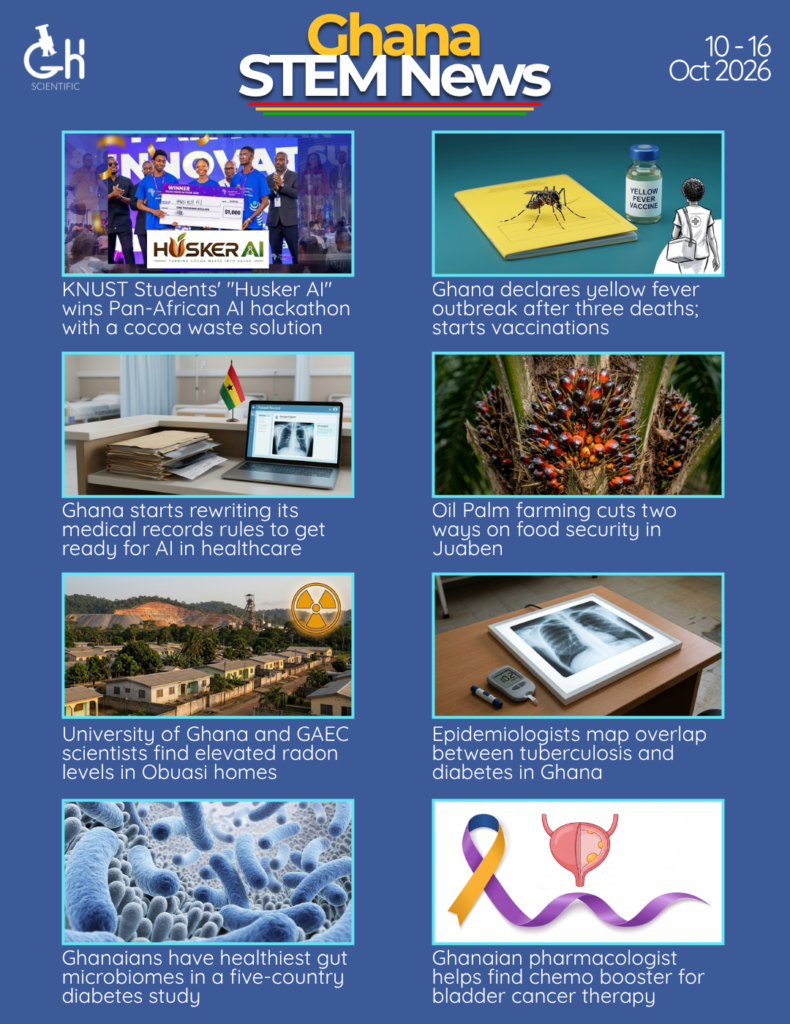
1. KNUST Students’ “Husker AI” Wins Pan-African AI Hackathon With a Cocoa Waste Solution
Source: MyJoyOnline
A student-led team from the Kwame Nkrumah University of Science and Technology (KNUST) — Frank Agyare, Caleb Antwi, Wilhelmina Adjah, Elijah Ayinomba, and Joseph Amankwaah — took first place in the Hack-AI-Thon at the 2026 Pan-African AI & Innovation Summit in Accra with a platform called Husker AI. Here’s the problem it tackles: when farmers crack open cocoa pods, the tough outer husk is usually left to rot, burned, or dumped, even though it can be turned into livestock feed, organic fertiliser, or biochar. Husker AI lets a farmer photograph their husks on a smartphone, then estimates the quantity, quality, and market value of the husks in Ghanaian cedis, while connecting them with buyers. Planned features include offline use and support for Twi, Ewe, and Fante, so the tool works without reliable data access or English literacy. The team won $1,000 in cash and startup mentorship, building on an earlier runner-up finish at the Ghana AI Innovation Challenge.
Why it matters: Cocoa is Ghana’s signature export crop, and a tool that turns a farm-level waste problem into an extra income stream — using nothing more exotic than a smartphone camera — is exactly the kind of practical, homegrown AI application worth celebrating.
2. Ghana Officially Declares a Yellow Fever Outbreak — Three Deaths in the Upper West Region
Source: Graphic Online
Health Minister Kwabena Mintah Akandoh formally declared a yellow fever outbreak this week after three laboratory-confirmed cases, all of them fatal despite intensive medical care. Yellow fever is a mosquito-borne viral disease spread mainly by the Aedes mosquito, and its symptoms — fever, jaundice (yellowing of the skin and eyes), and unusual bleeding — can escalate quickly without treatment. The affected patients came from the Sissala West and Wa West districts in the Upper West Region, with suspected cases first flagged back in September; samples were confirmed at a WHO-accredited laboratory in Dakar, Senegal. The declaration triggered an immediate response: national and regional Public Health Emergency Operations Centres are now active, Rapid Response Teams have been deployed for case-finding and surveillance, and an emergency vaccination campaign targeting Wa West, Sissala West, and Sissala East is rolling out this month. Officials are also urging residents to use insecticide-treated bed nets (including during the day, when Aedes mosquitoes are most active), clear stagnant water, and seek care immediately for fever or bleeding rather than self-medicating.
Why it matters: Yellow fever is both potentially fatal and vaccine-preventable, so this official declaration — a formal legal and logistical trigger that unlocks emergency vaccination and surveillance resources — is the clearest sign yet of how seriously Ghana’s health system is treating this outbreak.
3. Ahead of World Food Day, FAO and Ghanaian Researchers Push for AI and Science in Agriculture
Source: Ghana News Agency
With World Food Day landing on October 16, the UN’s Food and Agriculture Organisation (FAO) used a press briefing this week to call for more science, technology, and artificial intelligence in Ghana’s agriculture and food systems. FAO Representative to Ghana Dr Meshack Oguna Malo pointed to a simple example: a digital tool that helps a rabbit farmer predict birth dates, cutting losses from poor timing — proof, he argued, that useful innovation doesn’t have to be complicated or expensive. The briefing also surfaced sobering numbers from Dr Grace Forson of the Noguchi Memorial Institute for Medical Research: roughly 17.4% of Ghanaian children are malnourished, 45% of women of reproductive age have anaemia, and malnutrition costs Ghana an estimated 6.4% of its GDP every year. FAO is backing these calls with an initiative called “Innovate Today, Nourish Tomorrow,” while Aimee Wallin of the Ghana Food Movement argued that any tech-driven push should still draw on traditional food knowledge rather than sidelining it.
Why it matters: When malnutrition costs the country more than 6% of its GDP annually, pairing low-cost tech innovation with Ghana’s existing food knowledge stops being an abstract policy talking point and becomes a direct economic argument.
4. Ghana Starts Rewriting Its Medical Records Rules to Get Ready for AI in Healthcare
Source: WHO Africa
The Ghana Health Service, with WHO support, held a national workshop this week to review and update Ghana’s Medical Records Strategy and Operational Guidelines — rules that are nearly a decade old and were written before electronic health records, data-sharing between hospitals, and today’s cybersecurity concerns were everyday realities. Director-General Prof. Samuel Kaba Akoriyea opened the workshop by stressing that policy needs to be grounded in local expertise, while WHO’s Dominic Atweam represented the organisation’s Ghana office. Crucially, the revised guidelines are expected to directly address the responsible use of artificial intelligence in healthcare for the first time, alongside updated rules on interoperability (getting different hospital systems to talk to each other) and data governance. The workshop brought together health information professionals, legal experts, records officers, and digital health specialists to hash out what “responsible AI” should actually mean in a Ghanaian hospital.
Why it matters: You can’t safely bring AI diagnostic tools or predictive health systems into Ghanaian hospitals without first fixing the paperwork-level rules about who owns patient data, who can access it, and how it’s protected — so this unglamorous rules-update work is the quiet precondition for any of the flashier AI-in-healthcare promises making headlines elsewhere.
5. New KNUST Study: Oil Palm Farming Cuts Two Ways on Food Security in Juaben
Source: KNUST
A research team led by Seth Etuah at KNUST’s Department of Agricultural Economics, Agribusiness, and Extension — working with colleagues from CSIR-Crop Research Institute, Akenten Appiah-Menka University, and the UK’s Overseas Development Institute — published findings on how oil palm farming affects household food security, with KNUST spotlighting the results this week. In Juaben Municipality in the Ashanti Region, the picture is genuinely mixed. Households growing oil palm reported significantly worse food access than non-oil-palm households on a standard food-insecurity scale, yet those same households actually had more varied diets on a separate dietary-diversity measure. The researchers also found that across the study areas, nearly half of the land now growing oil palm was previously used for food crops — a direct trade-off between a valuable cash crop and local food production. The study appears in the journal Plant-Environment Interactions.
Why it matters: “Cash crops are good for farmers” is a tidy story, but this research shows the reality is more complicated — families can end up eating a more varied diet while simultaneously struggling to access enough food overall, and policymakers pushing oil palm expansion need to grapple with both halves of that trade-off, not just the half that looks good in a report.
6. Energy Minister Lays Out 2027 Targets: More Solar, 35 New Mini-Grids, and Nuclear Power Still on Track
Source: MyJoyOnline
Energy and Green Transition Minister John Jinapor used a ministerial planning session this week to set out Ghana’s energy priorities for 2027, and the numbers give a useful snapshot of where the country stands. Ghana’s installed electricity generation capacity currently sits at 5,854 megawatts, of which only 345 megawatts comes from renewable sources — a gap the minister wants to close by expanding solar projects, completing 35 new mini-grids (small, localised power systems that serve remote communities without a connection to the national grid), growing solar home systems and net-metering, and promoting cleaner cooking technologies. Nuclear power remains part of the long-term plan too, with Jinapor describing it as essential to a more diversified energy mix, though no new capacity figures or timeline were announced. Electricity access nationally stands at 89.13%. The minister also instructed energy-sector agencies to report what they delivered in 2026 against what they’ll need in 2027, while insisting that speed on new projects shouldn’t come at the cost of proper procurement.
Why it matters: Renewable sources make up less than 6% of Ghana’s installed power capacity, so a concrete 2027 target list — even a modest one like 35 mini-grids — is a useful yardstick for holding the energy sector accountable over the next year.
7. National TVET Week 2026 Kicks Off With a Push to “Reset” Technical and Vocational Training
Source: Citinewsroom
The Ghana TVET Service launched National TVET Week 2026 this week at the Dabokpa Technical Institute in Tamale, running October 12–16 under the theme “Resetting TVET for National Development.” TVET stands for Technical and Vocational Education and Training — the hands-on, skills-based alternative (or complement) to a traditional academic degree, covering fields like manufacturing, construction, agriculture, transport, digital technology, and the creative industries. Education Minister Haruna Iddrisu, delivering the keynote, called TVET “a strategic investment in Ghana’s future,” while Director-General Dr Eric Kofi Adzroe outlined goals including raising public awareness of technical careers, strengthening ties between training institutions and industry, and making sure graduates’ skills actually match what employers need. The five-day programme includes policy dialogues, industry engagement sessions, career guidance and mentorship, and exhibitions where learners showcase their own skills and innovations.
Why it matters: Ghana’s engineering and technology ambitions — from solar installation to vehicle maintenance to digital fabrication — all eventually run through the technical and vocational training pipeline, so a national week built around “resetting” that pipeline, rather than just celebrating it, suggests officials see real gaps between what’s being taught and what industry actually needs.
8. KNUST and China’s Hohai University Plan to Expand Partnership Into Renewable Energy and AI
Source: KNUST
A KNUST delegation led by Registrar Benjamin Boampong Owusu travelled to Nanjing, China, this week for talks with Hohai University — a Chinese institution known for its work in water resources, engineering, and related sciences — about expanding a partnership that began back in 2010. The two universities already run a joint double-bachelor’s programme in civil engineering and harbour and coastal engineering, launched in 2023, which has enrolled 60 students and graduated 32 so far. This week’s talks focused on going further: additional double-degree programmes, joint research laboratories, staff and student exchanges, and — notably — extending the collaboration beyond engineering into renewable energy, artificial intelligence, agriculture, and business. KNUST students currently studying at Hohai shared their experiences with the visiting delegation, and both sides agreed to work on translating these proposals into concrete academic programmes, though no funding or firm timelines have been announced yet.
Why it matters: International university partnerships like this one are how smaller research-and-training ecosystems like Ghana’s get faster access to specialised fields — in this case, renewable energy and AI expertise built up at a university with decades of water and energy engineering experience — without having to build every capability from scratch at home.
9. KNUST and CTVET Sign MOU to Expand Hands-On Skills Training
Source: KNUST
KNUST signed a memorandum of understanding this week with the Commission for Technical and Vocational Education and Training (CTVET) — the national body that sets standards for technical and vocational qualifications — to promote competency-based training, strengthen practical skills instruction, and better align what students learn with what employers actually need. CTVET Director-General Zakaria Sulemana suggested KNUST could start by offering short, practical courses for graduates of the College of Agriculture and Natural Resources, framing competency-based training as a tool against youth unemployment. Prof. Dadson Awunyo-Vitor, the College’s Provost, added that the partnership could extend further, letting district assemblies tap into the programme to train unemployed young people regardless of their educational background. KNUST Vice-Chancellor Prof. Christian Agyare called the MOU “a very good start” and pledged the university’s full backing.
Why it matters: This MOU is one more sign that Ghana’s universities and its vocational training regulator are trying to close the long-standing gap between academic credentials and job-ready skills — a gap that, when it isn’t closed, tends to show up later as youth unemployment statistics.
10. University of Ghana and GAEC Scientists Find Elevated Radon Levels in Obuasi Homes
Source: Radiation Protection Dosimetry
A research team based entirely at Ghanaian institutions — the University of Ghana’s School of Nuclear and Allied Sciences, the Ghana Atomic Energy Commission’s Radiation Protection Institute, Ghana’s Nuclear Regulatory Authority, and the University of Health and Allied Sciences in Ho — measured indoor radon gas in 150 homes in Obuasi, the Ashanti Region mining town, using detectors left in place for 180 days. Radon is a naturally occurring radioactive gas that seeps up from soil and rock (often concentrated by mining activity) and is a known contributor to lung cancer risk when it builds up indoors. The researchers, led by Rita Kpordzro, found that concrete-walled homes trapped the most radon while wooden homes trapped the least, bedrooms consistently had the highest readings (likely because people spend long, poorly ventilated hours there), and homes with paper-plastered walls and tiled floors fared better than those with painted walls and mortar floors. Based on these readings, estimated annual radiation doses ranged from 0.3 to 9.2 millisieverts, with 13% of the homes tested exceeding international safety reference limits.
Why it matters: This is exactly the kind of unglamorous, homegrown measurement science that protects people before a health problem even starts — a 13% exceedance rate is a concrete, actionable number that Ghana’s radiation regulators can use to write the country’s first national radon safety guidelines, rather than relying on standards borrowed from elsewhere.
11. Ghanaian Epidemiologists Map Where Tuberculosis and Diabetes Overlap Across the Country’s 16 Regions
Source: PLOS One
Richmond Balinia Adda of the University of Technology and Applied Sciences in Navrongo and Simon Subinleeb Bawa of the Navrongo Health Research Centre used publicly available health survey and surveillance data to map how tuberculosis (TB) and diabetes mellitus overlap across Ghana’s 16 administrative regions — a structure created in 2019 when the country expanded from 10 regions, which had scrambled a lot of older health-mapping data. Diabetes is a known risk factor for active TB, since it weakens the immune system’s ability to fight the infection. The researchers found TB notification rates ranging from about 19 to 58 cases per 100,000 people and diabetes prevalence ranging from 1.8% to 6.3% across regions, with diabetes cases clustering noticeably in the southern, more urbanised regions. The two diseases were moderately correlated at the regional level overall, but a few regions bucked the trend entirely — showing high TB rates alongside low diabetes prevalence — suggesting other factors are driving TB there instead.
Why it matters: A single national strategy for tackling TB and diabetes together makes less sense once you see that different regions are actually dealing with different combinations of the two diseases, and this kind of region-by-region mapping gives Ghana’s health planners the evidence to target resources where they’ll actually help, instead of applying a one-size-fits-all programme nationwide.
12. KNUST Physiologist Co-Authors Study Finding Ghanaians Have the Healthiest Gut Microbiomes in a Five-Country Diabetes Study
Source: Gut Microbes Reports
In a large international study involving Kweku Bedu-Addo of KNUST’s Department of Physiology, researchers examined gut bacteria and their byproducts (short-chain fatty acids, which gut microbes produce by fermenting fibre) in more than 1,500 adults of African descent living in Ghana, South Africa, Jamaica, Seychelles, and the United States, to see how both relate to type 2 diabetes risk. The standout finding: participants from Ghana had the highest gut microbial diversity and the highest levels of these beneficial fatty acids of any group studied, while participants in the United States had the lowest — a pattern the researchers link to Ghana’s still-largely fibre-rich traditional diet compared with more Westernised, ultra-processed eating patterns elsewhere. Across the whole study, diabetes was associated with lower microbial diversity, and the team identified specific bacteria linked to higher or lower diabetes risk, though the exact relationships varied somewhat from country to country.
Why it matters: As ultra-processed foods become more available in Ghana, this study offers an early, data-backed warning of what’s potentially at stake for gut health and diabetes risk if traditional, fibre-rich diets get crowded out — making a strong scientific case for protecting that dietary pattern rather than assuming “modernised” eating is automatically healthier.
13. Accra College of Medicine Pharmacologist Helps Identify a Potential Booster for Bladder Cancer Treatment
Source: Biomedicine & Pharmacotherapy
George J. Dugbartey, who holds a joint appointment at Accra College of Medicine in Accra and Western University in Canada, co-authored a laboratory study testing whether blocking a gas naturally produced in the body, hydrogen sulfide, could make standard bladder cancer treatment work better. In certain cancers, cells ramp up hydrogen sulfide production as a way of resisting chemotherapy, which is part of why non-muscle-invasive bladder cancer often comes back after treatment. Using both bladder cancer cells in the lab and a mouse model of the disease, the researchers found that a drug called PAG, which blocks the enzyme that produces hydrogen sulfide, slowed cancer cell growth and movement on its own, and significantly boosted the cancer-killing power of the chemotherapy drug gemcitabine when combined with it. Tumour shrinkage was even greater when PAG, gemcitabine, and the standard immunotherapy BCG were all combined — though this remains early-stage laboratory research, not yet tested in humans.
Why it matters: Non-muscle-invasive bladder cancer has a frustratingly high recurrence rate even after treatment, so a cheap, repurposable compound that measurably boosts existing chemotherapy’s effectiveness in lab models is a promising lead worth tracking as it (hopefully) moves toward human trials.
14. Komfo Anokye Teaching Hospital Physician Helps Build AI Tool to Predict Dementia Risk in Fatty Liver Disease Patients
Source: Journal of Alzheimer’s Disease Reports
Sarpong Boateng of Komfo Anokye Teaching Hospital in Kumasi joined an international research team, led by Yale University’s Basile Njei, in building machine-learning models to predict which patients with metabolic dysfunction-associated steatotic liver disease (MASLD, commonly known as fatty liver disease) are at highest risk of eventually dying from dementia-related causes, including Alzheimer’s disease. Using health and mortality data from nearly 1,800 American adults with MASLD, the team tested several types of predictive models and found that body measurements — waist circumference, body mass index, age, and whether someone has diabetes — were more useful for flagging dementia-mortality risk than existing liver-scarring (fibrosis) scores, which doctors currently rely on most. One of the models successfully flagged every dementia-related death in the study within its “high-risk” category, though the researchers caution this finding needs confirming in larger, more diverse groups of patients before it’s used in real clinics.
Why it matters: Fatty liver disease is increasingly recognised as something that can affect the brain as well as the liver, and a simple set of body measurements that predicts dementia risk better than existing liver tests — if confirmed in larger studies — could give doctors in Ghana and elsewhere a cheap, practical early-warning tool that doesn’t require expensive scans or labs.
That’s Your Ghana STEM News for the Week
From a KNUST student team’s prize-winning cocoa-waste app to a newly declared disease outbreak, a national push to get hospital records AI-ready, a cluster of university and ministry announcements touching energy, food security, and vocational training, and five freshly published research papers carrying Ghanaian institutional fingerprints, this week’s Ghana STEM news shows a country working several fronts of innovation at once. A health emergency in the Upper West Region and a sobering set of malnutrition statistics are reminders of the stakes involved, while policy moves on renewable energy, technical education, and international research partnerships show officials and institutions planning years ahead rather than just reacting to the present. And the research roundup — radon gas in Obuasi homes, TB and diabetes mapping, gut bacteria, bladder cancer, and dementia-risk prediction — is a reminder that Ghanaian scientists at the University of Ghana, KNUST, Komfo Anokye Teaching Hospital, Accra College of Medicine, and beyond are contributing to the global research record every single week, usually without headlines. Running underneath all of it is a consistent theme: Ghanaian researchers, students, and public servants are trying to make science and technology genuinely useful for ordinary problems — a farmer’s cocoa husks, a hospital’s paperwork, a village’s power supply, a mining town’s indoor air — rather than treating STEM as something abstract happening elsewhere. If a story here caught your eye, follow the source links above to read the full reporting, and check back next Friday for another round-up of the Ghana STEM news shaping the country.
Have a STEM story from Ghana we should cover next week? Reply and let us know.