
Your Friday catch-up on the science, tech, engineering, and health stories shaping Ghana — explained for everyone, not just the lab coats.
Welcome back to your weekly Ghana STEM news round-up. Every Friday we dig through what Ghanaian students, ministries, researchers, and health workers have been building, announcing, and discovering over the past seven days, and pull out the stories worth your five minutes — no science degree required. This week’s Ghana STEM news takes us from a university lecture hall buzzing with student-built robots to a yellow fever scare in the Upper West Region, a $202 million bet on faster mobile networks, and a trio of freshly published Ghanaian research findings on everything from wine safety to malaria genetics to turning coconut husks into a germ-fighting material. If there’s a theme running through this week’s Ghana STEM news, it’s range — from a three-day robotics showdown at the University of Ghana to the slower, peer-reviewed science that rarely makes headlines but quietly keeps checking whether our food, our drugs, and our understanding of disease hold up. Let’s get into it.
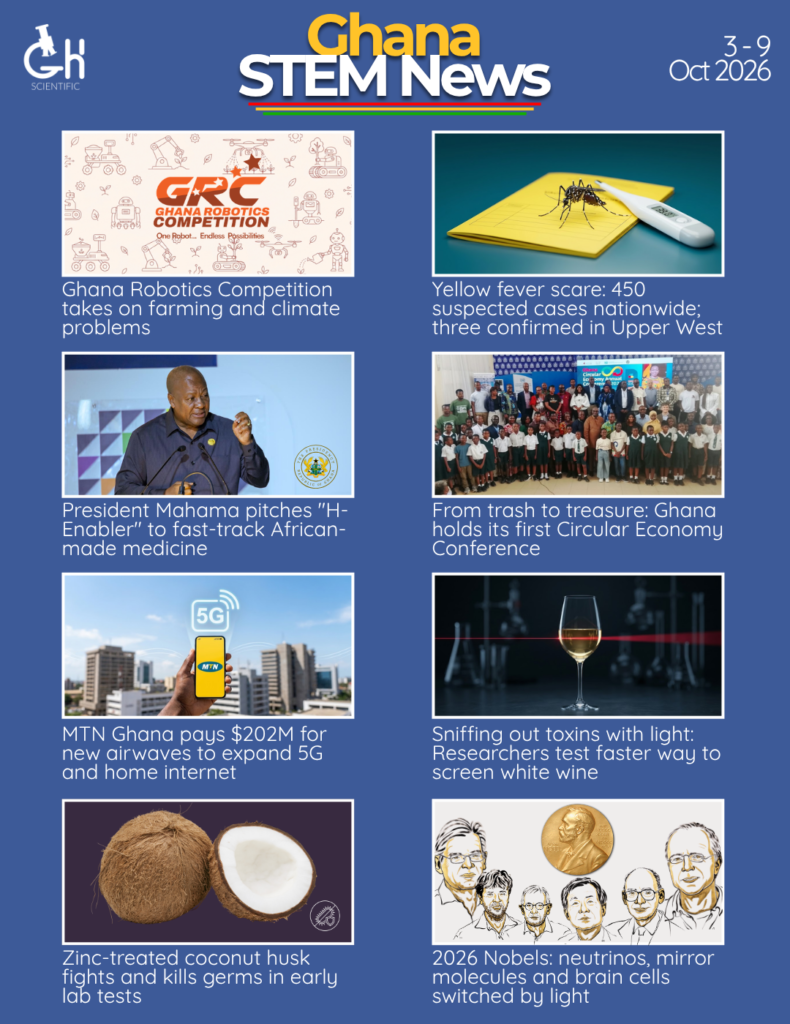
1. 2026 Nobel Prizes — Physics, Chemistry, and Medicine
Physics: Francis Halzen (Belgian-American, University of Wisconsin–Madison) won solely for his decisive role in building the IceCube Neutrino Observatory at the South Pole and discovering high-energy neutrinos of astrophysical origin — tiny, nearly massless particles that travel billions of light-years from cosmic sources like black holes, giving scientists a new way to “see” the universe beyond light.
Chemistry: Henri Kagan (France) and Kenso Soai (Japan) shared the prize for discovering non-linear effects and autocatalysis in asymmetric organic synthesis — work on how chemical reactions can selectively produce one “handed” version of a molecule (chirality) rather than a mixed batch, which matters enormously for making clean, effective pharmaceuticals.
Physiology or Medicine: Karl Deisseroth (Stanford), Peter Hegemann (Humboldt University Berlin), and Georg Nagel (University of Würzburg) shared the prize for their work on light-gated ion channels and optogenetics — techniques that let researchers switch individual nerve cells on and off with light, now used in labs worldwide to map how the brain actually works.
2. Robots, AgriTech, and Bragging Rights: The Ghana Robotics Competition Takes Over the University of Ghana
Source: Ghana Robotics Competition 2026
Ghana’s premier robotics showdown is underway this week, running October 7–9 at the GCB Lecture Hall on the University of Ghana campus. The 2026 edition of the Ghana Robotics Competition (GRC) is organised by Firefly IO — a Ghanaian STEM-education non-profit — in partnership with the University of Ghana’s School of Engineering Sciences, and it’s built around this year’s theme of AgriTech and environmental restoration, pushing student teams to design robots that tackle real farming and environmental problems rather than abstract challenges. Competitors are split into three leagues by age and experience: the Tech League for primary and junior high school pupils, the Stars League for senior high schoolers, and the Engineers League for university students, so a ten-year-old’s first robot and a final-year engineering student’s capstone project can share the same stage. The competition also serves as Ghana’s national qualifier, with top performers earning a shot at representing the country at the wider Pan-African Robotics Competition later in the year — a path previous Ghanaian teams have used to place among the continent’s best.
Why it matters: A robotics competition built around farming and environmental themes, rather than generic gadgetry, is a deliberate bet that the next generation of Ghanaian engineers will cut their teeth solving the problems the country actually has — and a shared stage for ten-year-olds and university seniors is exactly how that pipeline gets built one age group at a time.
3. A Yellow Fever Scare in the Upper West Region — 450 Suspected Cases and Counting
Source: MyJoyOnline
Health Minister Kwabena Mintah Akandoh told a government briefing this week that Ghana has recorded roughly 450 suspected yellow fever cases nationwide between June and September 2026, with 74 of those in the Upper West Region alone — three of which have been laboratory-confirmed. Yellow fever is a mosquito-borne viral disease, and “suspected” cases are patients whose symptoms match the illness but whose lab results aren’t back yet, which is why the minister stressed that nothing can be officially blamed on the disease until confirmation comes through. In response, authorities have ramped up surveillance in northern Ghana, supplied labs with testing reagents, deployed a National Rapid Response Team to the Upper West Region, and set aside isolated wards at district hospitals for suspected and confirmed patients. Akandoh urged calm, saying the response machinery was already in motion.
Why it matters: Yellow fever can be fatal but is also vaccine-preventable, so how quickly Ghana’s surveillance system turns “suspected” cases into confirmed diagnoses — and gets ahead of them — is a real-time test of the outbreak-response infrastructure the country has spent years building.
4. From Trash to Treasure: Ghana Holds Its First Circular Economy Conference
Source: Ghana News Agency
Ho Technical University hosted Ghana’s inaugural Circular Economy Annual Conference this week, bringing together the Ghana Circular Economy Centre (GCEC), UNIDO, and Canada’s development agency to tackle a blunt problem: Ghana generates plenty of waste, but not enough people, money, or systems exist yet to turn it into valuable products. Keynote speaker Cordie Aziz-Nash described a pilot project turning water hyacinth, recycled paper, and a cassava-based binder into packaging paper, and proposed a network of smaller, decentralised recycling hubs feeding into larger processors. GCEC’s Dr Marindame Kombale shared concrete progress — the Centre has already trained more than 2,500 entrepreneurs (58% women, 62% youth) and supported roughly 90 circular businesses and technologies — while stressing that the real bottleneck now is helping these early-stage ventures become “investable” enough to attract serious financing.
Why it matters: Ghana’s plastic, textile, and agricultural waste problem won’t be solved by collection trucks alone — it needs engineers, entrepreneurs, and financiers working the same supply chain, and this week’s conference is an attempt to get all three talking to each other.
5. President Mahama Pitches “H-Enabler” to Fast-Track African-Made Medicine
Source: Citinewsroom
Speaking at the Alamein Africa Forum in Egypt this week, President John Dramani Mahama announced “H-Enabler” — a Health Investment and National Gateway platform built with the African Medicines Agency, Institut Pasteur, and Afrochampions to simplify regulation, clinical validation, and commercialisation for health investors across Africa. His pitch rested on a stark figure: Africa currently imports more than 70% of its pharmaceuticals and nearly 99% of its vaccines, a dependency that drains money from the continent and leaves it exposed during health emergencies. Mahama is also deploying domestic “reform interlock observatories” through Ghana’s Accra Reset Presidential Council to track capital flows and strip away red tape affecting regional supply chains, and he’s pressing African regulators to speed up a harmonised drug-approval system so a single approval could open access across the whole continent.
Why it matters: Every pandemic and supply shock of the past decade has shown what happens when a continent can’t make its own medicines, so a platform explicitly designed to make African health manufacturing investable — not just desirable — is the kind of plumbing work that rarely makes headlines but could matter enormously if it works.
6. MTN Ghana Pays $202 Million for New Airwaves to Power Your 5G
Source: Citinewsroom
MTN Ghana was awarded new 5G and mobile broadband spectrum by the National Communications Authority this week — specifically two 20 MHz blocks in the 700 MHz band and a hefty 150 MHz in the 3 GHz band, both on 15-year licences. “Spectrum” is simply the radio frequencies carriers are legally allowed to transmit data over, and more of it means a network can carry more traffic without everyone’s connection slowing down at peak hours. The price tag is steep: $202 million total, split almost evenly between the two bands, which MTN says it has already built into its financial planning. The company says the new airwaves will support better coverage, faster 5G mobility services, and its push into home internet connectivity, though it hasn’t yet announced a rollout timeline or coverage targets.
Why it matters: Every AI tool, telemedicine app, and mobile banking service riding on Ghana’s networks depends on this kind of unglamorous spectrum infrastructure, so a $202 million bet signals MTN expects serious demand growth for data in the years ahead.
7. Sniffing Out Wine Toxins With Light: KNUST Researchers Test a Faster Way to Screen White Wine
Source: Food Chemistry, via PubMed
Ochratoxin A (OTA) is a toxin produced by mould that can contaminate grapes and end up in wine, and wine is the second-biggest dietary source of OTA in Europe after cereals — a real food-safety concern since the toxin is linked to kidney damage. Researchers led by Dr John-Lewis Zinia Zaukuu at KNUST, working with a Hungarian collaborator, tested whether shining near-infrared light through white wine — a technique called visible/near-infrared spectroscopy — could spot OTA contamination faster than standard lab chemistry. They combined this with “aquaphotomics,” which reads subtle changes in how water molecules within the wine absorb light depending on what’s dissolved in them, essentially using water’s own light “fingerprint” as a contamination detector. Testing three different white wine brands, the method predicted OTA concentration with strong accuracy in one brand (explaining 85–92% of the variation, depending on the exact light wavelengths used) but performed only moderately or poorly in the other two, showing that the wine’s own chemical makeup affects how well the trick works.
Why it matters: A light-based scan that could flag a contaminated bottle in seconds, without destroying the sample or needing a full chemistry lab, would be a genuinely useful tool for food-safety regulators and winemakers alike — though this study shows the method still needs fine-tuning before it works reliably across every type of wine.
8. Malaria Parasites May Be Finding a Way Around Nature’s Best-Known Defence
Source: Cell Reports, via PubMed
Carrying the sickle haemoglobin trait (HbS) is one of the best-documented examples of human evolution fighting back against disease — it’s long been known to cut the risk of severe malaria substantially. An international research team, including Dr Lucas Amenga-Etego of Ghana’s Navrongo Health Research Centre, sequenced malaria parasite genomes from infections in Gambian children and combined that data with earlier studies from Ghana, Mali, and Kenya — more than 6,000 people in total — to see whether the parasite itself might be adapting to blunt that protection. They found mutations in a parasite protein called CLAG3, part of the machinery the malaria parasite uses to pull nutrients into infected red blood cells, that are associated with cutting HbS’s protective effect roughly in half, along with several other previously unknown genetic links. The findings suggest the evolutionary arms race between the malaria parasite and the human genes that resist it is more complicated, and more actively ongoing, than scientists previously realised.
Why it matters: Sickle haemoglobin is especially common across West Africa, including Ghana, precisely because it offers malaria protection, so evidence that the parasite is evolving countermeasures matters both for understanding why malaria severity varies so much between individuals and for designing the next generation of treatments that target proteins like CLAG3 directly.
9. Turning Coconut Husk Waste Into a Germ-Fighting Material
Source: International Journal of Biomaterials, via PubMed
Biochar is a charcoal-like material made by heating organic waste with very little oxygen, and researchers led by Ralph Kwakye set out to see whether biochar made from coconut husks — a cheap, abundant waste product — could be turned into something genuinely useful by treating it with zinc. Plain, untreated coconut husk biochar showed essentially no ability to fight off bacteria or fungi in lab tests, but once the team modified it with zinc (creating tiny zinc oxide crystals bound to the charcoal), the material killed every bacterial and fungal strain they tested at a notably low concentration. The zinc-modified version also showed meaningful antioxidant activity, neutralising 67% of one type of damaging free radical and 58% of another in standard chemistry tests — properties that plain biochar didn’t have on its own. The researchers frame this as an early-stage finding and call for further testing before any real-world water-treatment or antimicrobial-surface product gets built from it.
Why it matters: Ghana produces plenty of coconut husk waste with few good uses for it, so a simple, low-cost zinc treatment that turns that waste into a material capable of killing bacteria and fungi is the kind of “trash to tool” research that could eventually support cheaper water treatment or infection control, especially in resource-limited settings.
That’s Your Ghana STEM News for the Week
From a robotics competition filling a university lecture hall with student-built machines to three freshly published Ghanaian studies probing wine safety, malaria genetics, and waste-derived antimicrobials, this week’s Ghana STEM news is a reminder that innovation in Ghana happens at every scale at once. A yellow fever response in the Upper West Region and a $202 million spectrum purchase show the country managing real, present-day risk and infrastructure, while a presidential pitch for African-made medicine and a first-ever circular economy conference show it planning years ahead. And underneath all of that, Ghanaian researchers at KNUST, Navrongo, and beyond keep publishing the kind of careful, peer-reviewed science that quietly checks whether our food is safe, our understanding of disease holds up, and our waste can be made useful — work that rarely makes headlines but is exactly what this week’s Ghana STEM news exists to surface. If a story here caught your eye, follow the source links above to read the full reporting, and check back next Friday for another round-up of the Ghana STEM news shaping the country.
Have a STEM story from Ghana we should cover next week? Reply and let us know.