
Your Friday catch-up on the science, tech, engineering, and health stories shaping Ghana — explained for everyone, not just the lab coats.
Welcome back to this week’s Ghana STEM news round-up. Every Friday we sift through what Ghanaian researchers, universities, ministries, and health workers have been building, announcing, and discovering over the past seven days, and pull out the stories worth your five minutes — no science degree required.
1. Yellow Fever Outbreak: Three Deaths Confirmed, 15 More Under Investigation in Upper West Region
Source: GhanaMMA
The yellow fever outbreak that Ghana’s Health Ministry officially declared in the Upper West Region has widened this week. While three laboratory-confirmed deaths remain the only cases verified so far — samples were tested in Ghana, then confirmed at a WHO-accredited lab in Dakar, Senegal — officials are now investigating 15 additional suspected deaths across Wa East, Sissala West, Sissala East, Nadowli-Kaleo, and Wa West. Suspected patients have shown fever, jaundice (yellowing of the skin and eyes), and unusual bleeding, the classic warning signs of this mosquito-borne viral disease. Meanwhile, the Ghana Health Service’s five-day emergency vaccination campaign in Wa West, Sissala West, and Sissala East — aimed at roughly 244,869 people aged nine months to 60 — ran its course this past week, with mobile teams reaching markets, churches, mosques, schools, and remote settlements. Public Health Emergency Operations Centres remain active, and rapid response teams are continuing surveillance and case-finding work.
Why it matters: A jump from 3 confirmed deaths to 18 under some stage of investigation is exactly the kind of number that can look alarming out of context, but it reflects more thorough surveillance, not necessarily a faster-spreading disease — and it’s precisely the kind of careful, methodical case tracking that Ghana STEM news watchers should want to see from a health system responding to an outbreak.
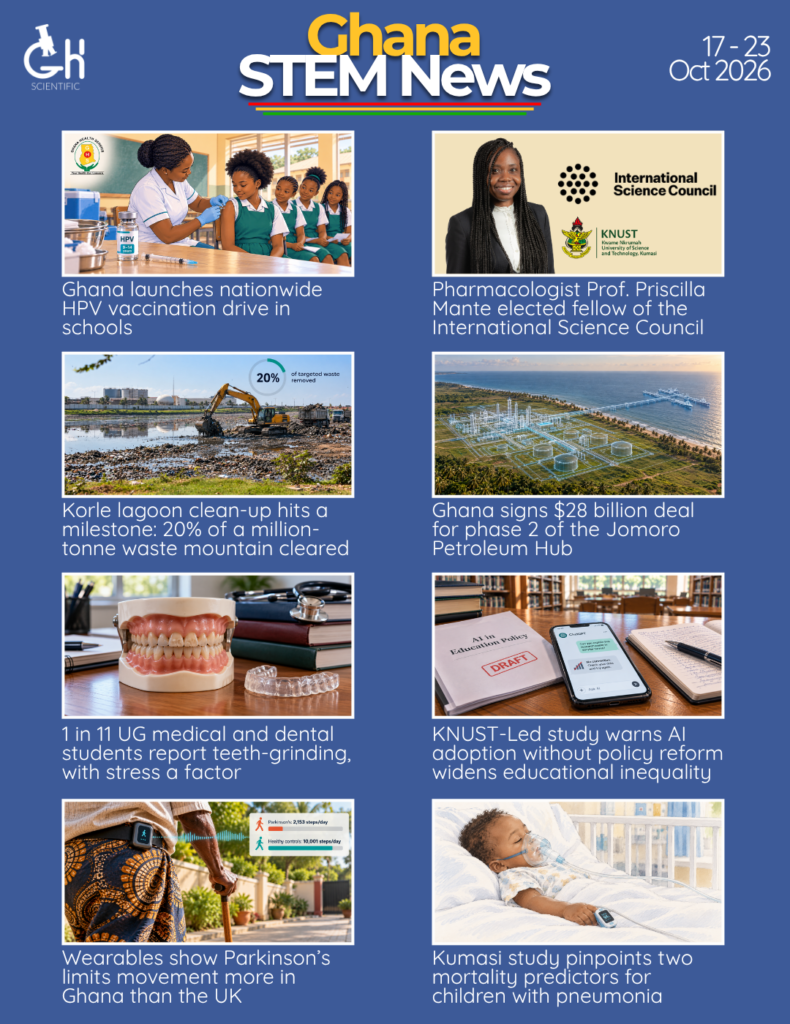
2. Ghana Launches Nationwide HPV Vaccination Drive in Schools This Week
Source: MyJoyOnline
The Ghana Health Service, working with the Ghana Education Service’s School Health Education Programme, is running the first of two nationwide rounds of HPV (human papillomavirus) vaccination in schools this week, from Monday, October 19 through Friday, October 23. HPV is a common virus that can cause cervical cancer in women years after infection, and the vaccine works best when given before girls become sexually active. Health teams are visiting schools across the country to vaccinate eligible girls aged 9 to 14 who haven’t yet received the shot, under a programme called the Periodic Intensification of Routine Immunisation. A second round is scheduled for the end of November into early December. The Ghana Health Service is asking school authorities, parents, and community leaders to support the teams and help identify girls who may have missed earlier rounds.
Why it matters: Cervical cancer is one of the most preventable cancers in medicine, and getting ahead of it with a vaccine, delivered directly into schools where girls already are, is a far cheaper and more effective public health strategy than treating the disease decades later — a genuinely good-news thread inside this week’s broader Ghana STEM news.
3. KNUST-Led Study Warns AI Adoption Without Policy Reform Could Widen Educational Inequality
Source: KNUST
A study led by Dr Jeffrey N. A. Aryee at KNUST’s Climate Diagnostics, Air Quality and AI Lab, funded by the Microsoft AI Economy Institute and published in the journal Frontiers in Education, looked at how universities in Ghana, Rwanda, and Namibia (plus survey respondents in Kenya and Zambia) are actually adopting artificial intelligence tools. The findings are a useful reality check on AI hype: adoption of AI tools in higher education is racing ahead of lecturer training, curriculum updates, and institutional governance. About half of survey respondents named financial barriers — tuition, certification fees, internet data, transport, and devices — as obstacles, and more than a third cited unreliable or expensive internet access. Women, students with disabilities, people in rural communities, and part-time students combining work and study were flagged as most at risk of being left behind. Ghana’s own pattern, researchers found, showed real institutional initiatives but poorly coordinated policy and implementation.
Why it matters: As Ghanaian universities and ministries race to bring AI into classrooms, this KNUST-led research is a timely warning that adopting the technology without matching investment in training, infrastructure, and governance risks turning AI into another gap between students who have resources and students who don’t — a core concern for anyone following Ghana STEM news on education policy.
4. Korle Lagoon Clean-Up Hits a Milestone: 20% of a Million-Tonne Waste Mountain Cleared
Source: Ghanaian Times
For years, a mountain of waste stretching from where the Korle Lagoon meets the sea at James Town, through Agbogbloshie and Old Fadama, has clogged one of Accra’s most notorious waterways and worsened flooding for thousands of nearby residents. This week brought genuinely encouraging news: a 90-day clean-up operation led by the Ministry of Local Government, Chieftaincy and Religious Affairs, with support from the Ghana Armed Forces’ 48 Engineer Regiment and the District Road Improvement Programme, has now removed roughly 20% of the estimated one million tonnes of waste targeted for removal. The waste heaps have long obstructed the waterway, worsened seasonal flooding, and exposed nearby communities to sanitation hazards. Officials say the clean-up is meant to pave the way for a larger urban renewal effort, including a proposed textile industry development for the area.
Why it matters: The Korle Lagoon’s waste problem has defeated multiple past clean-up attempts, so a verified 20% milestone — backed by military engineering support rather than just another announcement — is worth watching as a genuine test of whether this round of environmental engineering can actually finish the job.
5. KNUST’s College of Engineering Marks 75 Years, Announces New Technology Innovation Building
Source: KNUST
KNUST’s College of Engineering launched a year of 75th-anniversary celebrations this week under the theme “Excellence to Eminence.” Speakers, including Vice-Chancellor Prof. Christian Agyare and Provost Prof. Kwabena Britwum Nyarko, used the milestone to call for closer ties between academia and industry rather than just marking the occasion. The headline announcement was a planned Technology Innovation Building — a shared space where industry partners, researchers, students, and entrepreneurs can develop, test, and commercialise new engineering solutions together. The college also highlighted its existing Endowment Fund, which has grown to GH¢11.5 million since 2023 through alumni and industry contributions, and its engineering education support work in The Gambia and Rwanda. Mamponghene Daasebre Osei Bonsu III, a former Geomatic Engineering student at the college, specifically pointed to the value of geomatics and GIS tools in land administration and dispute resolution.
Why it matters: Seventy-five years of training Ghana’s engineers is a milestone worth marking on its own, but the real story is the college’s explicit pivot toward commercialising research through a dedicated building — a concrete bet on closing the long-standing gap between what universities discover and what actually gets built.
6. KNUST Pharmacologist Prof. Priscilla Mante Elected Fellow of the International Science Council
Source: KNUST
Prof. Priscilla Kolibea Mante, a Professor of Pharmacology at KNUST whose research focuses on epilepsy, depression, anxiety, and the therapeutic potential of African medicinal plants, was elected a Fellow of the International Science Council (ISC) this week — a global body that promotes science worldwide. The ISC describes the Fellowship, established in 2022, as the highest honour it can confer on an individual, recognising scientists and thought leaders who champion science “as a global public good.” The council now counts more than 200 Fellows internationally. Beyond her lab work, Prof. Mante has chaired the Ghana Young Academy, co-chaired the Global Young Academy, sits on UNESCO’s Global Advisory Committee for Women and Girls in Science, and founded WriteShop Ghana, a programme that builds research-writing skills among Ghanaian students and scientists.
Why it matters: Recognition like this doesn’t just celebrate one scientist’s career — it puts a Ghanaian researcher’s voice directly into the rooms where global science policy gets shaped, which matters for how African priorities, from medicinal-plant research to women’s participation in STEM, get represented on the world stage.
7. KNUST Immunologist Named Director of Research and Innovation at Ghana’s New National Research Fund
Source: KNUST
Prof. Alexander Kwarteng, an Associate Professor of Biochemistry and Biotechnology at KNUST whose research covers tuberculosis, meningitis, and neglected tropical diseases like river blindness and lymphatic filariasis, has been appointed Director of Research and Innovation at the Ghana National Research Fund (GNRF). The GNRF launched in June 2026 with GH¢100 million in seed capital and has published a Research and Innovation Strategy covering 2026 to 2030, built around the idea that government-funded research should produce practical, commercialisable solutions rather than sit in academic journals. Prof. Kwarteng, who holds a doctorate in Molecular Biomedicine from the University of Bonn and leads the Kumasi chapter of the Ghana Science Association, will now help shape how that GH¢100 million actually gets allocated across Ghana’s research institutions.
Why it matters: Whoever decides how a national research fund spends its money effectively decides which Ghanaian scientific priorities get built and which stay unfunded, so putting an infectious-disease immunologist with hands-on clinical-trial experience in that seat is a signal about where the GNRF’s early priorities may lean.
8. Ghana Signs $28 Billion Deal for Phase Two of the Jomoro Petroleum and Petrochemicals Hub
Source: Graphic Online
The Petroleum Hub Development Corporation signed a $28 billion Build-Own-Operate agreement this week with a Korea-Emirati-Mali consortium led by the firm Global Sphere, covering the second phase of the Ghana Petroleum and Petrochemicals Hub at Jomoro in the Western Region. The plan is large in engineering terms: a refinery capable of processing 300,000 barrels of oil per day, two petrochemical plants, four million cubic metres of storage, and a multi-berth jetty, built over five years, with construction targeted to start in early 2027. Energy Minister Dr John Abdulai Jinapor argued that Ghana’s oil output can’t translate into real economic value unless the country processes more of its own crude rather than exporting it raw — Ghana currently operates only two refineries. The consortium stressed that this signing is a step toward securing financing, not the finished deal; equity, debt, and risk-mitigation arrangements are still being arranged.
Why it matters: A refinery of this scale would process far more oil than Ghana itself consumes, positioning the country as a potential fuel supplier for the wider West African sub-region — but the project’s fate now hinges on financing arrangements that are explicitly still unresolved, so this is one to watch rather than celebrate just yet.
9. World Food Day in Bono East: Rural Women Farmers Call for Irrigation and Support for Local Food Systems
Source: MyJoyOnline
Women farmers in Forikrom, in Ghana’s Bono East Region, marked World Food Day this week with a local food durbar at the training camp of the Abrono Organic Farming Project, organised together with the Rural Women Farmers Association of Ghana. Under the global theme “Innovate Today, Nourish Tomorrow,” farmers, extension officers, nutrition experts, and traditional leaders discussed a sobering regional backdrop: more than 36 million people across West and Central Africa currently struggle to get enough to eat. Speakers championed locally grown, organic food and a “four-star diet” nutrition framework for balanced eating, while agriculture officials specifically called for irrigation systems that would let farmers, especially in the Upper West Region, grow food year-round instead of depending entirely on seasonal rains.
Why it matters: The scientific case for irrigation investment is simple but easy to overlook amid bigger headlines: rain-fed farming leaves food production at the mercy of an increasingly unpredictable climate, and a reliable water supply is one of the most proven, lowest-tech interventions available for actually stabilising a farming household’s income and nutrition year-round.
10. University of Ghana Study Finds Teeth-Grinding Common Among Stressed-Out Dental and Medical Students
Source: PubMed
Researchers led by Shadrach Terifu-Nenom Daabaar and Joseph Kwasi Nimako-Boateng at the University of Ghana’s Korle Bu campus surveyed 291 clinical-year dental and medical students about bruxism — the clinical term for grinding, clenching, or bracing the teeth and jaw — and how it relates to stress, in a study published this week in the International Journal of Dentistry. Only 19.6% of students demonstrated good knowledge of bruxism overall, and dental students knew far more than their medical-student peers (48.8% versus 14.5%). Using a validated screening questionnaire, 9.3% of all students met the threshold for self-reported bruxism symptoms, even though only 8.9% reported high perceived stress. Stress levels and bruxism symptoms were weakly but significantly correlated, meaning more stressed students tended to report more grinding and clenching, though the link wasn’t strong enough to explain bruxism on its own.
Why it matters: Catching teeth-grinding early matters because, left unchecked, it can wear down teeth and trigger painful jaw disorders, and this study’s finding that Ghana’s future doctors know far less about it than future dentists points to a simple, low-cost fix: folding basic bruxism and stress-management education into the medical school curriculum, not just the dental one.
11. Wearable Sensors Reveal Parkinson’s Disease Hits Mobility Harder in Ghana Than in the UK
Source: PubMed
In a study published this week in Frontiers in Aging Neuroscience, researchers from the University of Ghana Medical School, including neurologist Prof. Albert Akpalu, teamed up with Newcastle University and other partners on a project called TraPCAf to test, for the first time in an African population, whether a small wearable sensor could reliably track real-world movement in people with Parkinson’s disease. Fifty Ghanaians with Parkinson’s and 30 healthy older adults wore the device for seven days, generating 24 separate measures of daily walking and movement, which researchers then compared against a similar study of Parkinson’s patients in the UK. Ghanaian Parkinson’s patients took dramatically fewer steps per day than Ghanaian controls (about 2,153 versus 10,001) and walked for far less time overall (roughly 26 minutes versus just over two hours). Strikingly, the Ghanaian patients’ mobility impairment was more severe than the UK patients’ even after researchers adjusted for other differences between the two groups, although most participants found the wearable device acceptable to use despite some reported discomfort.
Why it matters: Parkinson’s disease is widely under-diagnosed and under-treated across Africa due to a shortage of specialists, and this is the first study to show, with objective sensor data rather than a doctor’s subjective impression, that the disease may be hitting Ghanaian patients’ ability to move around harder than it hits patients in wealthier countries — a gap researchers say now needs investigating through diagnosis delays, medication access, and other lifestyle and healthcare factors.
12. What Predicts Death in Children Hospitalised With Severe Pneumonia in Kumasi
Source: PubMed
A team led by Sandra Kwarteng Owusu and colleagues at Komfo Anokye Teaching Hospital and KNUST tracked 3,086 child hospital admissions across six health facilities in the Kumasi Metropolis for a study published this week in Pediatric Pulmonology, screening 506 children for pneumonia and admitting 266 with severe cases, most of them under two years old. Nine percent of the children admitted with severe pneumonia died, and of those deaths, 15 happened within just 24 hours of admission, underlining how quickly the illness can turn fatal in young children. The strongest warning signs researchers identified were poor feeding, which more than tripled a child’s risk of dying, and low blood-oxygen levels, while children whose oxygen saturation stayed above 90% were far more likely to survive. Common symptoms on admission included cough, fast or difficult breathing, and fever.
Why it matters: Pneumonia remains one of the leading killers of young children worldwide, and this study hands frontline nurses and clinicians in Kumasi’s hospitals two simple, measurable red flags — poor feeding and low oxygen saturation — that can help them identify which admitted children need the most urgent attention, even in settings where advanced diagnostic equipment isn’t always available.
That’s Your Ghana STEM News for the Week
From a widening health investigation in the Upper West Region to a nationwide cervical-cancer vaccination push, a KNUST study cautioning against AI hype in classrooms, genuine progress on Accra’s long-suffering Korle Lagoon, two Ghanaian scientists stepping into influential new roles, a $28 billion bet on domestic oil refining, rural women farmers calling for irrigation in Bono East, and three freshly published research papers on teeth-grinding, Parkinson’s mobility, and child pneumonia, this week’s stories show a country working on protection and infrastructure as much as discovery. The outbreak and vaccination stories are reminders that public health in Ghana is a live, ongoing effort rather than a solved problem, the engineering and research-leadership stories point toward longer-term bets — on commercialising university research, on cleaning up decades of urban waste, and on deciding who shapes a brand-new national research fund — and the research roundup is a reminder that Ghanaian scientists at the University of Ghana, KNUST, and Komfo Anokye Teaching Hospital are contributing to the global research record every single week, usually without headlines. Running underneath all of it is a familiar theme for anyone who follows Ghana STEM news closely: Ghanaian institutions, from KNUST to the Ghana Health Service to a newly signed engineering consortium, are being asked to turn plans and funding into results that ordinary Ghanaians can actually feel, whether that’s a cleared waterway, a vaccinated schoolgirl, or a hospital ward that catches a sick child’s warning signs in time. If a story here caught your eye, follow the source links above to read the full reporting, and check back next Friday for another round-up of Ghana STEM news.
Have a STEM story from Ghana we should cover next week? Reply and let us know.