
Your Friday catch-up on the science, tech, engineering, and health stories shaping Ghana — explained for everyone, not just the lab coats.
Welcome back to your weekly Ghana STEM news round-up. Every Friday, we sift through what Ghanaian researchers, regulators, engineers, and entrepreneurs have been building, debating, and fixing over the past seven days, and pull out the stories worth your five minutes — no science degree required. This week’s Ghana STEM news takes us from a brand-new physics lab in Kumasi to a solar-powered tap in a small Volta town, by way of Parliament, the ocean, and a snakebite ward in the Oti Region. There’s a recurring theme running through several of this week’s stories, too: Ghana isn’t just adopting technology, it’s starting to write the rules for it — for electric cars, for artificial intelligence, and for who gets to use its coastline data. Let’s get into it.
1. Let There Be (Ghanaian) Light: KNUST Opens Ghana Photonics Lab
Source: Ghana News Agency
Kwame Nkrumah University of Science and Technology (KNUST) has opened the Ghana Photonics and Optics Laboratory (GPOL), the country’s first such facility housed at a university and only its second dedicated optics and photonics lab overall. Photonics is the science of generating and controlling light, and it underpins everything from fibre-optic internet to medical scanners; this new lab, built by Dr Akyana Britwum and Dr Michael Kweku Edem Donkor with seed funding from the International Society for Optics and Photonics (SPIE), is equipped to test pharmaceuticals, detect parasites, and monitor water and soil quality using light-based instruments. Its launch coincided with the NYANSAPƆ Photonics School for Health and Safety, which brought 38 students from six African countries to Kumasi to train on the new equipment. KNUST Provost Professor Philip Antwi-Agyei put the stakes plainly: “A country that cannot use light well can buy answers from other people” — a nod to the fact that Ghanaian labs, hospitals, and farms currently have to send many optical measurements abroad.
Why it matters: The global photonics market was worth an estimated $2.5 trillion in 2024, and a home-grown lab means Ghanaian researchers and clinics can run their own light-based tests locally instead of paying and waiting for results from overseas.
2. Ghana Signs On to Watch Its Coastline From Space
Source: Space in Africa
Ghana has become the sixth African country to join the Space4Ocean Alliance, a global network that links space agencies with ocean and maritime institutions to put satellite data to work protecting coastlines. The Ghana Space Science and Technology Institute’s director, Dr Joseph Bremang Tandoh, signed the declaration during the International Space Summit in Paris, joining Gabon, Kenya, Djibouti, Senegal, and Angola among the alliance’s 32 total members. The agreement itself doesn’t come with cash or new hardware — it’s a platform for finding partners and expert networks — but Ghana says it plans to pursue collaborations in shoreline monitoring, coastal-flood assessment, marine-pollution detection, mangrove protection, fisheries management, and blue-economy development. The motivation is close to home: the Gulf of Guinea coastline, especially around Keta and Ada in the Volta River delta, has been losing ground to erosion and flooding for years.
Why it matters: Satellites can watch an entire coastline update by the week in a way ground surveys never could, so plugging into a network like this is how a country with limited monitoring budgets still gets access to world-class ocean data.
3. Parliament Gets Its First Rulebook for Electric Cars and Battery Swap Stations
Source: Ghana News Agency
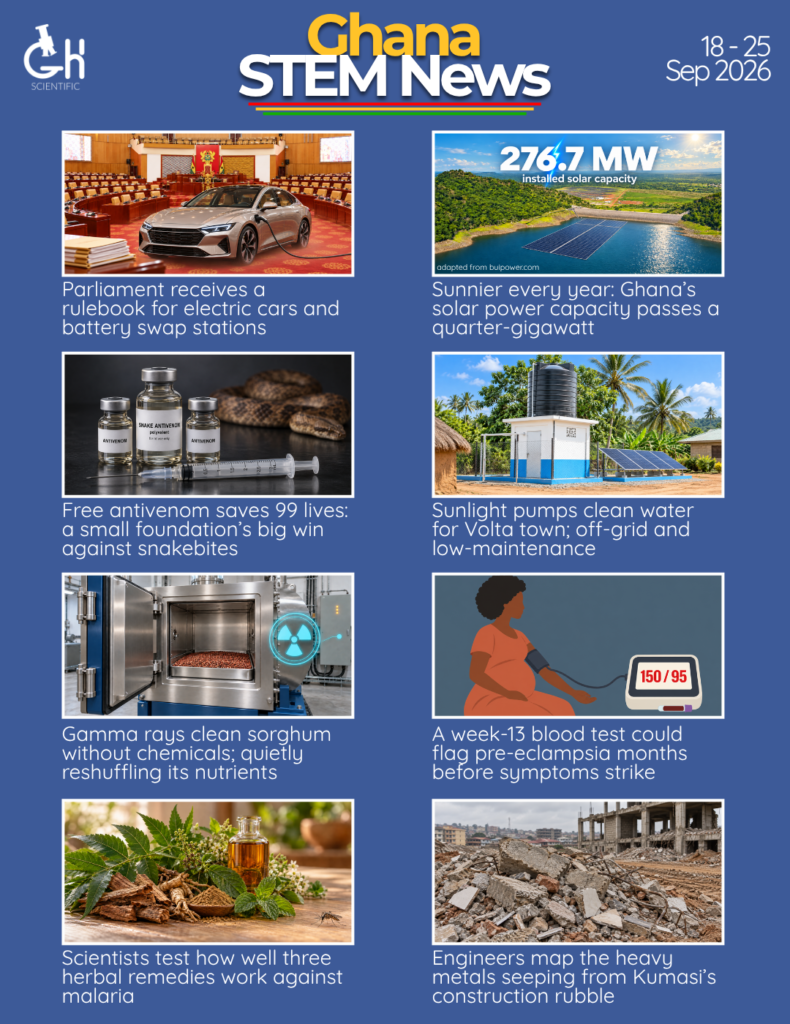
Ghana’s Energy Commission has formally laid the Electric Vehicle Charging Station and Battery Swap Systems Regulations, 2026 before Parliament, setting out safety standards, licensing rules, and registration procedures for the country’s growing electric-mobility sector. Acting Executive Secretary Adwoa Serwaa Bondzie explained the thinking behind regulating a technology that’s still relatively new here: “The objective of a Commission is not to restrain innovation. It is to ensure that innovation develops a sound foundation.” The regulations, expected to clear Parliament in October, will run alongside a new national platform the Commission is building to monitor licensed charging stations, track energy use, and assess the strain EVs put on the power grid. The announcement came at a ceremony certifying 884 electricians under a newly updated electrical wiring code that, for the first time, covers solar systems, battery storage, and EV charging installations.
Why it matters: A patchwork of unregulated, unsafe charging equipment is exactly the kind of thing that can quietly derail public trust in electric vehicles — getting the rulebook in place now, while the EV market here is still small, is far easier than retrofitting safety onto it later.
4. Zapping Sorghum With Radiation: What Gamma Rays Do to a Staple Grain’s Nutrients
Source: SAGE Journals, via PubMed
Sorghum is a drought-tough grain grown widely across northern Ghana, and one way to protect stored grain from pests and mould without chemicals is irradiation — exposing it to a controlled dose of gamma rays or an electron beam, the same basic idea already used to sterilise some spices and packaged foods. Researchers, working with Ghana’s Biotechnology and Nuclear Agriculture Research Institute (BNARI) at the Ghana Atomic Energy Commission alongside an international irradiation partner, wanted to know whether decontaminating sorghum this way also changes its healthy plant compounds. They exposed sorghum grain to five radiation doses using three different sources — gamma rays, a low-energy electron beam, and a high-energy electron beam — then measured levels of flavonoids and phenolic acids (natural plant compounds linked to antioxidant activity, which is the ability to neutralise cell-damaging molecules) using laboratory chromatography and two standard antioxidant tests. The results were not a simple “more radiation, more change”: depending on the radiation source and dose, phytochemical levels sometimes rose and sometimes fell, and gamma rays had the biggest overall effect on the grain’s antioxidant activity compared to either electron beam method.
Why it matters: Grain losses to pests and mould are a real problem for Ghanaian farmers and food processors, and irradiation is a promising, chemical-free fix — but this study is a reminder that regulators and processors need to choose the radiation source and dose carefully, since decontaminating a grain can also quietly shift its nutritional profile.
5. One Small Town, One Big Tap: Solar Power Brings Water to Agblonu
Source: Ghana News Agency
Volta Regional Minister James Gunu marked his birthday this week by commissioning a solar-powered mechanised borehole in Agblonu, a community in the Akatsi North District. The system pairs a 3-kilowatt solar array with a 10,000-litre overhead storage tank, giving residents a steady supply of potable water without relying on diesel pumps or the local electricity grid. “For me, birthdays are not only about celebration but also about giving back and making a meaningful difference in the lives of our people,” Gunu said at the commissioning, while the district’s Chief Executive urged residents to look after the new equipment so it keeps running. It’s a modest project by national standards, but it follows a pattern this round-up has flagged before: solar-powered infrastructure in smaller Ghanaian towns tends to keep working long after conventional, grid-dependent systems fall into disrepair.
Why it matters: A borehole that runs on sunlight instead of subsidised diesel or an unreliable grid connection is one less thing that breaks down when fuel prices spike or the power goes out — small, but exactly the kind of practical engineering that rural Ghana benefits from most.
6. Do Ghana’s Popular Herbal Malaria Remedies Actually Work? Scientists Put Three to the Test
Source: Journal of Tropical Medicine, via PubMed
“Polyherbal antimalarials” — malaria remedies made by blending several medicinal plants into one product — are sold widely across Ghana, but rigorous scientific testing of whether they actually work has been scarce. A team of Ghanaian researchers set out to change that, buying three widely available polyherbal products (labelled Samples A, B, and C) from pharmacies and markets in Accra and Kumasi, then testing them directly against malaria parasites in the lab, including a strain resistant to the standard drug chloroquine. They measured potency using something called an IC50 value — essentially, the dose needed to kill half the parasites in a sample, where a lower number means a more powerful effect — and found that Samples A and B were genuinely potent against young-stage parasites in both drug-resistant and drug-sensitive strains, while Sample C was noticeably weaker; all three lost strength against the parasite’s more mature stages. Crucially, the researchers also ran safety tests in rodents following international (OECD) guidelines and found all three products safe at the doses tested, with no toxic effects on cells or animals.
Why it matters: Millions of Ghanaians already reach for herbal antimalarials, especially when a clinic is far away or a pharmacy bill is a stretch, so independent lab testing like this is one of the few ways to find out which popular products genuinely fight malaria and are safe to use — while confirming they’re still no substitute for WHO-recommended antimalarial drugs, particularly against the parasite stage responsible for spreading the disease between people.
7. What’s Leaking Out of Kumasi’s Construction Rubble? Engineers Map the Heavy Metals Underneath
Source: Environmental Monitoring and Assessment, via PubMed
Every demolished building or construction site leaves behind rubble — broken concrete, tiles, and debris, known as construction and demolition waste (CDW) — that in Ghana’s fast-growing cities is often simply dumped rather than treated. A team of Ghanaian engineers tested CDW and the soil around a construction site in Kumasi for six heavy metals: lead, arsenic, zinc, copper, manganese, and cadmium, all of which can harm soil health, plants, and microbial life at high enough concentrations. They found the waste was mostly sand, which lets contaminated water (“leachate”) move through it easily, and used two computer-modelling techniques to map how far the metals were spreading both sideways and downward through the ground. Copper, zinc, and manganese turned out to be highly mobile, travelling well beyond the original waste pile, while lead and arsenic tended to stay put closer to where they started. The researchers are now calling for stronger regulation, more sustainable construction practices, and chemical treatments that lock the metals in place to limit the damage.
Why it matters: As Ghanaian cities keep building and rebuilding, untreated construction rubble is quietly becoming a pollution source — mapping exactly which metals travel and which stay put gives city planners a scientific basis for deciding where treatment is urgent versus where the risk is more contained.
8. Week 13: Scientists Pinpoint a Critical Turning Point for a Dangerous Pregnancy Condition
Source: Placenta (Elsevier), via PubMed
Pre-eclampsia is a serious high-blood-pressure disorder that can develop during pregnancy, threatening the health of both mother and baby, and one of the biggest challenges in fighting it is that warning symptoms usually show up too late for early intervention. A joint team from the University of West London and KNUST’s Centre for AI in Healthcare turned to cell-free RNA — tiny genetic fragments that leak from the placenta into a pregnant woman’s bloodstream and can be captured with a simple blood draw — to hunt for earlier warning signs. Analysing 228 blood samples taken between the 8th and 16th weeks of pregnancy, comparing women who later developed pre-eclampsia (including severe cases) against those with normal pregnancies, the researchers found something striking: a major shift in gene activity at gestational week 13 specifically, with nearly 2,900 genes behaving differently than at other points in pregnancy, pointing to changes in immune response, cell energy production, and cell survival pathways. Later stages of pregnancy showed far fewer such changes, and four genes in particular — MYZAP, CAV2, OXTR, and GBP1 — stood out as promising early biomarkers worth testing further. The authors are careful to note that this needs validation in larger, forward-looking studies before it becomes an actual clinical test.
Why it matters: Pre-eclampsia remains a leading cause of pregnancy complications and maternal death in Ghana and worldwide, so identifying a specific, testable window as early as week 13 raises the possibility of a first-trimester blood test that flags high-risk pregnancies months before dangerous symptoms would otherwise appear.
9. Free Antivenom, 99 Lives Saved: A Small Foundation’s Big Win Against Snakebite
Source: Ghana News Agency
In the farming communities of Krachi Nchumuru District in the Oti Region, where snakebites are a routine occupational hazard, the Jerry John Yenabi Foundation says its programme supplying free anti-snake venom to local health facilities has saved 99 lives. Before the intervention, the cost of antivenom often meant delayed treatment while families scrambled for money — and with snakebite, delay can be the difference between recovery and death or permanent injury. “Early reporting and prompt administration of anti-snake venom were critical to improving chances of recovery,” said the Foundation’s CEO, Jerry John Yenabi, while nurse Kumado John Jnr urged residents not to wait before seeking care. It’s not a laboratory breakthrough, but it’s a reminder that in public health, removing a simple financial barrier can be just as life-saving as inventing a new drug.
Why it matters: Snakebite is often called a “neglected tropical disease” precisely because it rarely makes headlines, even though it kills and disables thousands of people across rural Africa each year — a targeted, low-cost fix like this one shows how much difference a single well-run local programme can make.
10. Sunnier Every Year: Ghana’s Solar Power Capacity Passes a Quarter-Gigawatt
Source: pv magazine
Ghana’s Ministry of Energy and Green Transition has confirmed that the country’s total installed solar photovoltaic (PV) capacity reached 276.7 megawatts (MW) by the end of 2025, according to its updated Renewable Energy Master Plan for 2026-2030. Of that, 183.1 MW comes from utility-scale plants feeding directly into the national grid, 86 MW from distributed solar installations serving businesses and institutions, and 7.6 MW from rooftop systems on homes. The tally includes contributions from the 100 MW Bui solar complex, 28 MW at Kaleo, 20 MW each from the BXC and Meinergy plants, 6.5 MW at Lawra, and a 5 MW floating solar installation on the Bui reservoir. It’s a modest figure by the standards of larger economies, but it represents years of steady, deliberate build-out rather than one headline-grabbing mega-project.
Why it matters: Every megawatt of solar capacity is a megawatt Ghana doesn’t have to generate by burning fuel oil or relying on hydropower that dips during dry seasons — and a clear master plan gives investors and engineers a target to build toward instead of guessing.
11. Ghana’s Fisheries Chief to Scientists: Stop Just Publishing, Start Fixing the Ocean
Source: MyJoyOnline
Ghana’s Ministry of Fisheries and Aquaculture Development has called on the Ghana Science Association and the wider research community to turn their findings into practical, science-based solutions for protecting the country’s ocean and coastal livelihoods — collectively known as the “Blue Economy.” The Minister proposed setting up a joint technical body between the Ministry and the Science Association to tackle fish-stock assessment, climate adaptation, and coastal resilience together, and pushed back on research that stops at an academic publication instead of a policy recommendation. The timing lines up with a draft Blue Economy Commission Bill, which has cleared technical review and is now going through stakeholder consultation before heading to Cabinet and Parliament, expected by October 2026. Officials also stressed that illegal mining, destructive fishing methods, and other harmful coastal activity can’t be solved by better science alone — it also takes the right policies, funding, and trained people.
Why it matters: Ghana’s fishing communities are watching stocks decline in real time, so a push to convert academic research into an actual technical body with policy teeth is a meaningful step beyond the usual conference-hall calls for “more studies.”
12. Ghana’s Mobile Money Machine Just Moved Half a Trillion Cedis in a Single Month
Source: Citinewsroom
New Bank of Ghana data shows mobile money transactions hit GH¢518.8 billion in August 2026 alone, a 46.5% jump from the same month last year. Ghanaians carried out 1.046 billion mobile money transactions during the month, up from 969 million in July, using a network that now counts 85.8 million registered accounts (26.4 million of them active) and 594,000 active agents nationwide, up from 550,000 the month before. The total float sitting in the mobile money system — essentially the digital cash parked in wallets and agent accounts — reached GH¢39.8 billion. None of this involves flashy new hardware, but it’s a snapshot of how thoroughly digital payments have replaced cash for everyday transactions across the country, from market stalls to school fees.
Why it matters: A financial system processing over half a trillion cedis a month through phones rather than bank branches is a genuine piece of homegrown fintech infrastructure — and it’s the quiet backbone that lets everything from government subsidy payments to small-business loans move faster and reach more people.