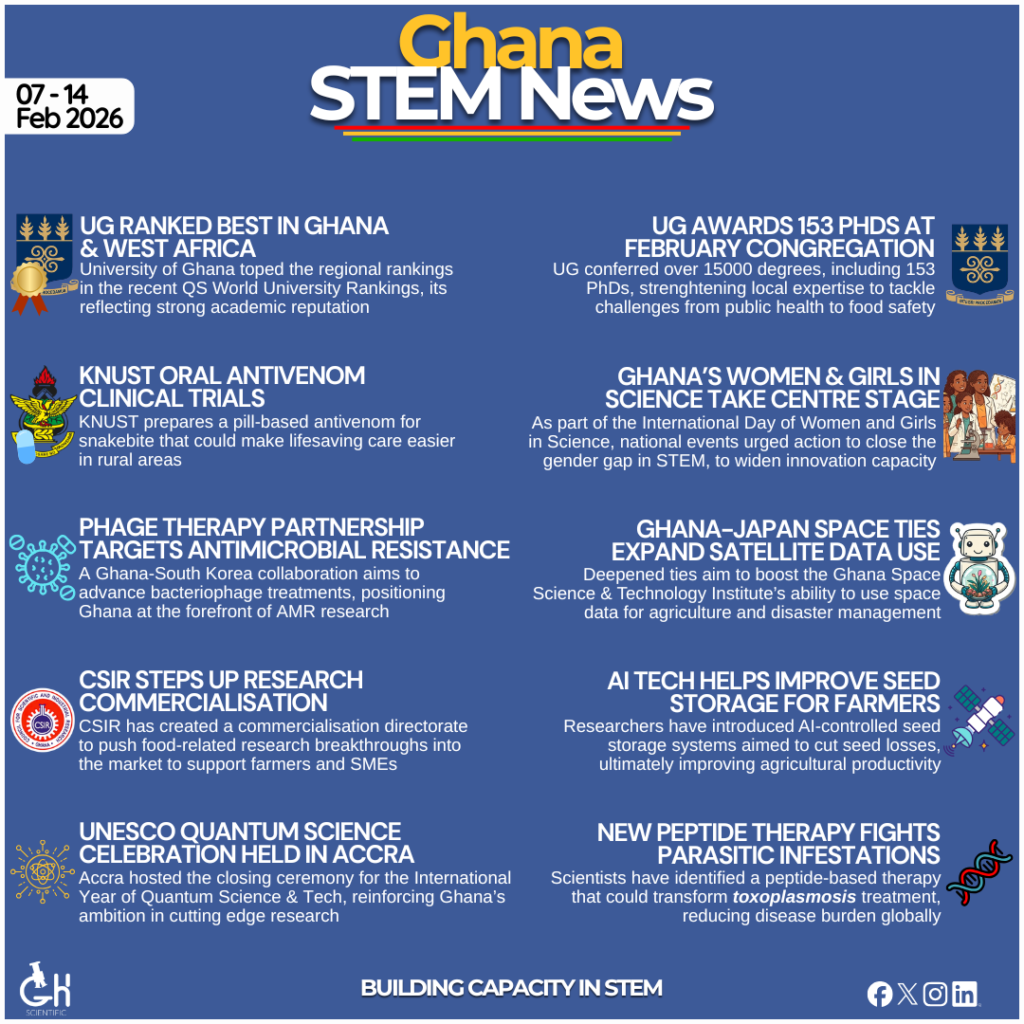
From health breakthroughs to space cooperation and university milestones, it was a busy week for Ghana STEM news. Here are the headlines, why they matter, and where to read more.
1) University of Ghana awards 153 new PhDs at February Congregation
What happened: The University of Ghana (UG) conferred 15,288 degrees, including 153 PhDs, across its Colleges of Basic & Applied Sciences, Education, Health Sciences and Humanities during its February 2026 ceremonies. Leaders highlighted a push for impactful research, partnerships and infrastructure improvements. [gna.org.gh], [ghanabusin…ssnews.com]
Why it matters (in plain terms): More PhDs means more home‑grown experts tackling local problems—from food security to public health. That strengthens Ghana’s research capacity and boosts innovation in everyday life, from clinics to classrooms. [gna.org.gh], [ghanabusin…ssnews.com]
2) UG named Best in Ghana & West Africa in new QS regional ranking
What happened: University of Ghana was ranked best in Ghana and West Africa and 8th in Sub‑Saharan Africa in the QS World University Rankings: Sub‑Saharan Africa 2026, reflecting strong academic reputation, global research networks and sustainability. [ug.edu.gh]
Why it matters: Rankings aren’t everything, but they help universities attract talent and funding. For families and employers, they’re a signal that local degrees carry growing international weight—good news for future jobs and research collaborations. [ug.edu.gh]
3) KNUST flags upcoming oral antivenom clinical trial for snakebite care
What happened: An upcoming clinical trial of oral antivenoms, aiming to transform snakebite treatment with the use of pills especially in high‑burden rural communities in the Upper West Region is scheduled to take place at KNUST. [knust.edu.gh]
Why it matters: Snakebite is a silent public‑health emergency that can cause lifelong disability. An effective pill‑based therapy would be easier to store, transport and administer than injections, potentially saving lives in remote clinics. [knust.edu.gh]
4) Ghana’s women & girls in science take centre stage
What happened: Around the International Day of Women and Girls in Science (Feb 11), the Ghana Education Service and partners held exhibitions and talks urging action to close the gender gap in STEM education and careers. [myjoyonline.com], [ghanaweb.com]
Why it matters: When more girls stick with science, the talent pool doubles—and solutions improve. Showcasing student projects and role models helps make STEM feel welcoming and realistic for all learners. [myjoyonline.com], [ghanaweb.com]
5) Phage therapy partnership launches to tackle antimicrobial resistance (AMR)
What happened: The West Africa Centre for Innovative Research and Care (WAFCIRC) in Kumasi signed a landmark collaboration with South Korea’s MicrobiotiX to advance bacteriophage‑based therapies—viruses that selectively kill bacteria—through clinical studies in Ghana. [tmcnet.com], [markets.fi…ontent.com]
Why it matters: Drug‑resistant infections make common illnesses dangerous. If phage treatments prove safe and effective here, Ghana could help pioneer new tools against superbugs—and build local clinical research capacity along the way. [tmcnet.com], [markets.fi…ontent.com]
6) AI Tech Helps Improve Seed Storage for Farmers
What happened: Researchers introduced AI-controlled seed storage systems to tackle major crop losses caused by poor storage conditions, with the final goal being to cut seed losses
Why it matters: Smart technologies like AI can improve agricultural productivity — a key sector in Ghana — by making food systems more efficient and resilient
7) CSIR steps up commercialisation of research for food security and jobs
What happened: The Council for Scientific and Industrial Research (CSIR) told Parliament it has created a commercialisation directorate to push research outputs (from improved foods to post‑harvest technologies) into the market through MoUs with farms and agro‑processors, training and exhibitions. [ghanabusin…ssnews.com]
Why it matters: Research only changes lives when it reaches farmers, SMEs and consumers. Helping innovations scale can strengthen value chains, improve food and nutrition security, and create jobs. [ghanabusin…ssnews.com]
8) Ghana–Japan space ties deepen around satellites & data use
What happened: Ghana’s Embassy in Tokyo hosted a working meeting with Axelspace and Cross U on strengthening collaboration with the Ghana Space Science and Technology Institute (GSSTI)—building on a January trade mission workshop in Accra focused on space data for forestry, disaster management and agriculture. [tokyo.mfa.gov.gh]
Why it matters: Satellite imagery helps monitor illegal mining, protect forests and plan farms. Boosting Ghana’s capacity to use and produce space data turns science into practical public services and business opportunities. [tokyo.mfa.gov.gh]
9) UNESCO Quantum Science Celebration Held in Accra
What happened: The closing ceremony for UNESCO’s International Year of Quantum Science & Technology took place in Accra, bringing global experts to Ghana to advance discussions on quantum research and education
Why it matters: Ghana’s role in hosting global quantum science events showcases its ambition to be part of cutting-edge science and invest in future technology talent
10) A New Peptide Therapy Fights parasitic infestations
What happened: Scientists have identified a promising new peptide-based therapy that could transform how we treat Toxoplasma gondii infections — a parasite that can cause toxoplasmosis, particularly dangerous for people with weakened immune systems. This research was supported by Dr. Elvis Quansah from Akenten Appiah-Menka University of Skills Training and Entrepreneurial Development, Mampong-Asante, Ghana.
Why it matters: Toxoplasmosis affects millions worldwide and can be life-threatening in people with weakened immunity, such as those living with HIV or undergoing chemotherapy. A new treatment like C8 could significantly reduce the disease burden by offering:
- Greater effectiveness than existing drugs.
- Lower toxicity, improving quality of life for patients.
- A model for peptide-based therapies against other intracellular parasites.