
In a significant move to bolster Ghana’s digital future, the Ghana Chamber of Telecommunications (GCT), in partnership with the Ghana Education Service (GES), has officially launched it’s digital skills initiative, “Signal To Coding”. Unveiled on June 10, 2026, the program marks a major evolution in the Chamber’s efforts to equip young learners with essential Science, Technology, Engineering, and Mathematics (STEM) skills .
The initiative was introduced through an interactive robotics workshop held at the Rosharon Montessori School in Tema Community 12, where approximately 100 upper primary and junior high school pupils received hands-on training . Led by facilitator Enoch Abban from the Mingo Foundation, the session moved beyond traditional theoretical instruction, allowing students to design, build, and program their own robots.
“We believe the first point of engagement is children, helping them understand from signal to coding how telecommunications works and how they can leverage technology to build their coding and robotics capabilities,” stated Sylvia Owusu-Ankomah, Chief Executive Officer of the Ghana Chamber of Telecommunications.
The event, powered by Helios Towers Ghana and facilitated by the Mingo Foundation, focused on developing critical thinking, creativity, teamwork, and problem-solving skills.
Building on a Legacy of Digital Education
The Signal To Coding Initiative represents the next generation of the Chamber’s long-standing commitment to STEM outreach, significantly expanding upon its predecessor, the Coding Caravan project.
Over the past five years, the Coding Caravan successfully introduced thousands of students in under-served and hard-to-reach communities to foundational digital skills, including basic coding, animation, Internet of Things (IoT), and 3D design. For example in 2023, GCT along with the Institute of ICT Professionals, Ghana (IIPGH) trained 200 girls in the Akyem Oda, Eastern Region.
While the Caravan was instrumental as an awareness and introductory tool—focusing on “experiential teaching” using software like Scratch—the new Signal To Coding Initiative builds on that foundation by placing a heavier emphasis on advanced robotics and emerging technologies. Furthermore, mobile workshops across regions like Volta and Central, shift toward deeper, more intensive partnerships with specific schools to create sustainable, long-term learning environments rather than one-off awareness tours.
Beyond the Coding Caravan, the Chamber has also championed the Seats For Ladies In STEM (S4LIS) initiative, launched in December 2022. S4LIS is a targeted effort to increase female participation in STEM fields, aiming to raise the percentage of women in STEM jobs from 30 percent (as of 2021) to 40 percent by 2031. Former Chamber CEO Patricia Obo-Nai called on corporate Ghana to be deliberate in increasing women’s participation in STEM, and the S4LIS initiative represents that commitment to gender diversity and inclusion alongside the Chamber’s youth-focused coding programs.
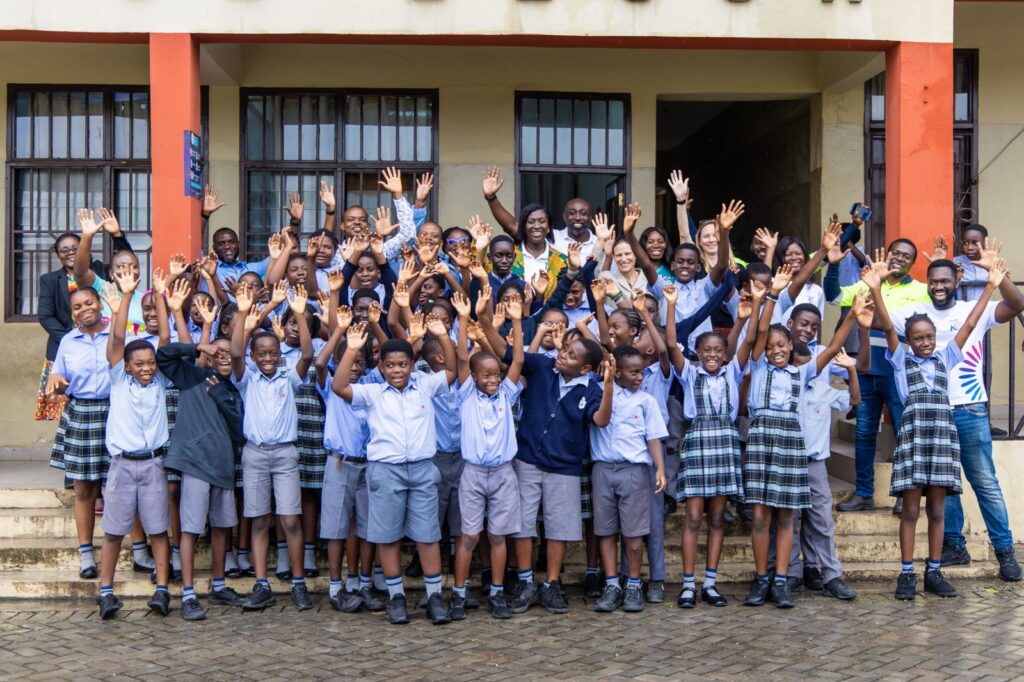
The Signal To Coding launch at Rosharon Montessori School signals a shift toward deeper, intensive partnerships with specific schools and the GES to create sustainable, long-term learning environments. By integrating robotics and systems thinking, the Chamber is ensuring that students are not just passive consumers of technology but active creators ready for the demands of a technology-driven world.
A Call for Sustained Practical Learning
Ms. Bernice Ofori, Tema Metropolitan Director of Education, reaffirmed the GES’s commitment to prioritizing STEM education, noting that exposing pupils to coding and robotics at an early age will help build a generation capable of driving innovation and national development.
The Chamber has long advocated for a shift in Ghana’s education system from rote memorization to practical application. As noted by Dr. Kenneth Ashigbey, CEO of the Chamber, during previous programs, “Teaching ICT for our children in a manner that requires them to memorize concepts doesn’t help” . The Signal To Coding Initiative is the direct execution of that philosophy, ensuring that students are not just passive consumers of technology but active creators ready for the demands of a technology-driven world.
Source: Ghana Chamber of Communications