
Your Friday catch-up on the science, tech, engineering, and health stories shaping Ghana — explained for everyone, not just the lab coats.
Welcome back to this week’s Ghana STEM news round-up. Every Friday we comb through what Ghanaian institutions, agencies, and researchers have been building, testing, warning about, and announcing over the past seven days, and pull out the stories worth your five minutes — no science degree required.
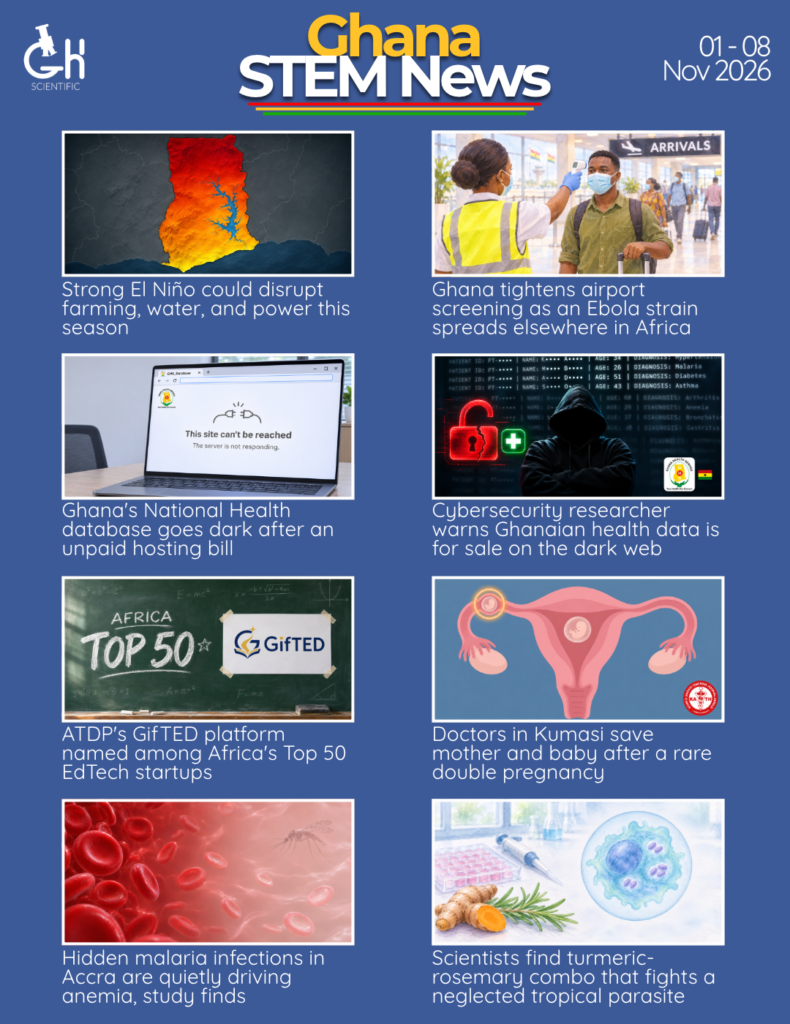
1. Weather Agency Warns a Strong El Niño Could Disrupt Farming, Water, and Power This Season
Source: Citi Newsroom
The Ghana Meteorological Agency (GMet) has issued an updated seasonal outlook warning that a very strong El Niño — the periodic warming of surface waters in the Pacific Ocean that scrambles rainfall patterns worldwide — is developing for the 2026–27 period. Crucially, GMet is careful to say El Niño doesn’t automatically mean drought or flooding everywhere in Ghana; its actual effects here depend heavily on what’s happening separately in the tropical Atlantic Ocean, and some of the country’s worst climate shocks in recent years actually happened outside El Niño years. Still, the agency flagged four areas of concern: crop production, water resources, hydroelectric power generation (since Ghana relies heavily on dams like Akosombo for electricity), and public health risks tied to shifting rainfall and rising temperatures. This year has already delivered a preview of that unpredictability — heavy rain caused widespread flooding in parts of southern Ghana back in June, while prolonged dry spells hit farming further north later in the year. GMet’s own updated outlook points to normal-to-below-normal rainfall across much of the country for the rest of the year, with some pockets of above-normal rain, and warmer-than-average temperatures almost everywhere.
Why it matters: For a country where farming still employs a huge share of the workforce and electricity still leans on hydropower, an early, honest warning from meteorologists — one that resists oversimplifying a complex climate signal — is exactly the kind of practical Ghana STEM news that farmers, utilities, and emergency planners can actually act on before the season turns.
2. Ghana Tightens Airport Screening as an Ebola Strain Spreads Elsewhere in Africa
Source: Ghana News Agency
Ghana’s Ministry of Health has rolled out stricter screening at the country’s three international airports in response to an outbreak of Ebola caused by the Bundibugyo virus strain in several other African countries. Ghana has recorded no confirmed Ebola cases, and officials are explicit that these are precautionary measures that will be reviewed as the situation changes, not a sign of local transmission. Under the new rules, every arriving traveler fills out a Health Declaration Form disclosing recent travel to or through affected countries, plus any contact with suspected cases, visits to treatment facilities, or participation in funeral rites for suspected victims — a detail that matters because funeral practices have historically been a major transmission route for Ebola in past outbreaks. Everyone undergoes non-contact temperature screening, and anyone flagged for symptoms, travel history, or possible exposure gets a secondary health assessment and, if needed, temporary isolation. Travelers from countries with active transmission face up to 21 days of monitoring after arrival, matching the virus’s maximum incubation period, and hotels are now required to notify local health authorities when guests arrive from affected countries. The Ministry’s statement closed with a plea for the public to avoid spreading misinformation about the outbreak.
Why it matters: Ebola’s case-fatality rate makes it one of the few diseases where “we have zero cases so far” is genuinely good news worth protecting, and layered, proportionate airport screening — rather than panic or complacency — is the textbook public-health response while the outbreak is still contained elsewhere.
3. Ghana’s National Health Database Went Dark After an Unpaid Hosting Bill
Source: GBC Ghana Online
On October 29, the Ghana Health Service’s cloud hosting provider switched off all ten servers running the country’s main electronic health platforms, after the Service fell behind on its hosting bill. The casualties include DHIMS2, the primary national system for collecting and reporting health data; platforms tracking family planning, HIV, tuberculosis, malaria, and non-communicable disease cases; and the system that shares birth notifications between health facilities, the National Identification Authority, and the Births and Deaths Registry. Director-General Dr Samuel Kaba Akoriyea told regional health directors on November 2 to go back to paper — manual registers and monthly summary forms — until systems come back online, with the backlog entered into DHIMS2 once service resumes. Officials stressed there was no security breach and no data loss, since encrypted nightly backups exist outside the suspended account; the problem is financial, not technical. The Service is now choosing between settling the roughly US$64,500 balance to simply flip the existing system back on, or building new servers and restoring from backup, which could take up to six weeks. Looking ahead, GHS says it’s weighing a move to a Ghana-based hosting provider, with a properly funded backup arrangement so this doesn’t happen again.
Why it matters: A country can build sophisticated electronic health systems for tracking everything from malaria to maternal mortality, but as this week showed, that entire apparatus is only as resilient as the invoice behind it — a sobering reminder that digital health infrastructure needs the same budget discipline as the hospitals and clinics it serves.
4. Cybersecurity Researcher Warns Ghanaian Health Data Is Already for Sale on the Dark Web
Source: GBC Ghana Online
Speaking on GTV’s Breakfast Show, cybersecurity researcher David Gyedu said he regularly monitors the dark web and has found a platform claiming to be selling data stolen from a Ghanaian health institution. He pointed to a vulnerability that gets little public attention: much of the medical scanning and diagnostic equipment used in Ghanaian hospitals is imported, raising open questions about where the data it generates is actually stored and who manages it. Gyedu argued Ghana still lacks a strong policy framework for protecting health data specifically, and used the same interview to flag a fast-growing, more personal threat: AI-generated voice cloning, now accurate enough from as little as three seconds of audio that a phone call “from” a family member asking for emergency money can no longer be trusted at face value. His practical advice for spotting deepfake video: watch for unusually smooth facial features, odd dark patches around the chin, unnatural mouth movements, and irregular blinking. His broader recommendation: a dedicated national cybersecurity budget, more public awareness, and security resources that reach beyond Accra to Ghana’s other regions.
Why it matters: This warning landed in the very same week Ghana’s own national health database went offline over a billing dispute, which makes Gyedu’s underlying point — that health data protection in Ghana is under-resourced on multiple fronts at once — considerably harder to dismiss as hypothetical.
5. ATDP’s GifTED Platform Reportedly Named Among Africa’s Top 50 EdTech Startups
Source: ATDP (see editor’s note below — this item could not be fully independently verified before publishing)
Ghana’s Academic Talent Development Program (ATDP), the Accra-based organization behind youth-education initiatives such as Miss STEM Ghana and the Ghana Tech Olympiad, is reported to have had its GifTED platform named among the top 50 edtech startups in Africa — the kind of annual continental ranking that groups like HolonIQ publish to spotlight promising education-technology ventures.
Why it matters: A Ghanaian-built platform cracking a top-50 African edtech list is a genuinely good story worth celebrating.
6. Doctors in Kumasi Save Mother and Baby After a Rare Double Pregnancy
Source: J Med Case Rep, via PubMed
At Komfo Anokye Teaching Hospital (KATH) in Kumasi, doctors successfully treated a 34-year-old woman carrying two separate pregnancies at once: one growing normally inside her uterus, and a second growing outside it, in her fallopian tube — a rare condition called heterotopic pregnancy. She arrived at the emergency room in shock, with dangerously low blood pressure, after the outside-the-uterus pregnancy ruptured and caused massive internal bleeding; surgeons found more than a litre of blood had pooled in her abdomen. They operated immediately, removing the ruptured fallopian tube and pregnancy while carefully avoiding any disturbance to the healthy, normally sited pregnancy. That pregnancy went on to reach full term under close monitoring, and the woman delivered a healthy 2.5 kg baby girl at 38 weeks. Published cases of this complication being caught and successfully managed are still rare in sub-Saharan Africa, making this a valuable record for other clinicians.
Why it matters: Heterotopic pregnancy is notoriously easy to miss because doctors often stop looking once they’ve spotted one normal pregnancy on ultrasound, so this case is a pointed reminder — especially in busy, resource-limited emergency rooms — to keep scanning for a second, hidden danger when a pregnant patient shows up with sudden, severe abdominal pain.
7. Hidden Malaria Infections in Accra Are Quietly Driving Anemia, Study Finds
Source: Malaria Journal, via PubMed
Researchers at Korle Bu Teaching Hospital tested 345 outpatients in Accra and found that about a third were carrying malaria parasites without showing any symptoms at all — and nearly half of those quiet infections were so faint (“submicroscopic”) that they wouldn’t show up on a standard rapid test or even under a microscope. Detecting them required a more sensitive lab technique called LAMP-PCR, which can spot fragments of parasite DNA at levels ordinary tests miss entirely. Both the everyday low-level infections and the ultra-faint submicroscopic ones were linked to measurably lower hemoglobin, a marker of anemia, even in people who felt perfectly healthy. One particular blood marker — low MCHC, a measure of how much hemoglobin is packed into each red blood cell — turned out to be the strongest predictor of carrying one of these hidden infections.
Why it matters: Ghana’s malaria elimination push has focused heavily on symptomatic cases, but this study suggests a silent reservoir of infection may be quietly contributing to anemia and keeping transmission going under the radar, meaning elimination efforts may eventually need more sensitive diagnostics, not just more bed nets.
8. University of Ghana Scientists Find a Turmeric-Rosemary Combo That Fights a Neglected Tropical Parasite
Source: PLoS Neglected Tropical Diseases, via PubMed
A University of Ghana team tested combinations of natural plant compounds — including curcumin, the compound that gives turmeric its color, and rosmarinic acid, found in herbs like rosemary — against Leishmania donovani, the parasite behind visceral leishmaniasis, a severe and often fatal disease that disproportionately affects poor communities. Working with lab-grown parasites and infected mouse immune cells, they found curcumin and rosmarinic acid together worked only modestly against the parasite’s free-swimming form, but became meaningfully more powerful — a “synergistic” effect, where the combination outperforms what adding the two compounds’ individual effects would predict — against the harder-to-treat form that hides and multiplies inside immune cells. The combination seemed to work partly by starving the parasite of iron it needs to survive, while also boosting the host immune cell’s own inflammatory defenses. Crucially, the treatment was selective enough to hit the parasite hard while leaving the host’s own cells largely unharmed.
Why it matters: Visceral leishmaniasis has few affordable, low-toxicity treatment options, so finding that two plant-derived compounds already used in food and traditional medicine can work together against the parasite’s hardest-to-treat stage is an early but encouraging step, though the authors are clear it still needs testing in live animals before it could ever reach patients.
That’s Your Ghana STEM News for the Week