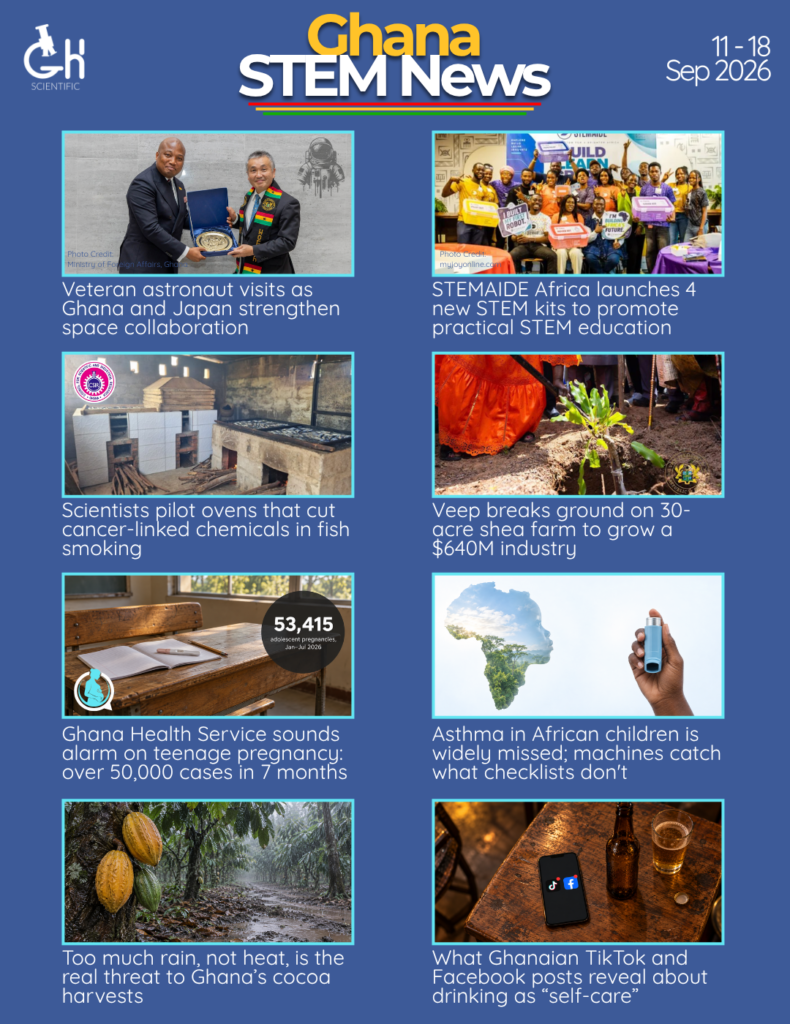

Your weekly catch-up on the science, tech, engineering, and health stories shaping Ghana — explained for everyone, not just the lab coats.
Welcome back to your weekly Ghana STEM news round-up. Every Friday, we dig through what Ghanaian researchers, engineers, entrepreneurs, and public institutions have been up to over the past seven days, and pull out the stories worth knowing — no science degree required.
This week’s Ghana STEM news takes us from the International Space Station to a fish-smoking shed in the Eastern Region, by way of a shea farm in the north that just shaved two decades off a tree’s growing time. Let’s get into it.
1. Ghana Hosts a Veteran Astronaut as It Deepens Space Cooperation With Japan
Source: MyJoyOnline
Dr. Koichi Wakata — a Japanese astronaut who has flown five space missions, logged 504 cumulative days off-planet, and became the first Japanese commander of the International Space Station back in 2014 — spent September 15 to 19 in Ghana as part of a push to deepen space cooperation between the two countries. Foreign Affairs Minister Samuel Okudzeto Ablakwa, Japanese Ambassador Hiroshi Yoshimoto, and University of Ghana Vice-Chancellor Professor Nana Aba Appiah Amfo were all part of the talks, which focused on how satellite technology can support agriculture, communications, environmental monitoring, and disaster management here at home. Officials described space exploration as “a global undertaking that required collaboration among countries, scientists, engineers and institutions,” and pointed to knowledge-exchange programmes for Ghanaian students and researchers as a next step, building on Japan’s earlier support for Ghana’s satellite programme.
Why it matters: You don’t need your own rocket to benefit from space science — satellite data already helps track floods, monitor crops, and plan disaster response, and a visit like this is Ghana positioning itself to get more of that expertise and technology transferred onto home soil.
2. What Ghanaian TikTok and Facebook Posts Reveal About Drinking as “Self-Care”
Source: JMIR Infodemiology
A team of researchers from the University of Ghana, the University of California, San Francisco, and the Africa Interdisciplinary Research Institute set out to understand something public health surveys rarely capture: how ordinary Ghanaians talk about alcohol when nobody official is asking. They analysed 189 publicly available posts from Facebook and TikTok using discourse analysis, a method that treats everyday language as a place where meaning gets built and shared, rather than just counting how many people drink or how much. What they found was that alcohol was consistently framed not as a health risk but as a coping tool — for stress, heartbreak, and financial strain — and as social glue that facilitated friendship, leisure, and a sense of belonging. The researchers also identified a blended “commercial-lay” discourse online, where alcohol brands’ promotional messaging, wellness-style claims, and ordinary peer conversation blur together, collectively linking drinking with vitality, relaxation, and emotional restoration. The study is described as one of the first qualitative looks at alcohol-related social media discourse anywhere in West Africa.
Why it matters: Most alcohol health campaigns lead with risk statistics and warnings, but this research suggests that on the platforms where Ghanaians actually talk about drinking, alcohol is already being sold to itself as self-care and connection — meaning public health messaging that doesn’t engage with those same emotional and cultural narratives is competing on the wrong terms.
3. A Safer Way to Smoke Fish: Scientists Pilot Ovens That Cut Cancer-Linked Chemicals
Source: Ghana News Agency
Ghana’s Council for Scientific and Industrial Research – Food Research Institute (CSIR-FRI), working with the University of Bergen in Norway, has begun piloting a redesigned version of the traditional Chorkor smoking oven — a fixture in fish markets across the country since 1969. The problem the retrofit is solving: fish smoked in old-style ovens can pick up polycyclic aromatic hydrocarbons, or PAHs — smoke-borne compounds linked to cancer — at levels that exceed international safety limits. A more advanced “Ahotor” oven design already exists and cuts PAH contamination, but it never caught on widely because it’s expensive and complicated to build; the new retrofitted Chorkor oven adds a simple fat-collecting tray to the familiar, affordable design instead, aiming to deliver similar safety gains without asking processors to abandon equipment they already know how to use. The pilot is running across six communities in the Eastern, Greater Accra, Volta, and Central regions.
Why it matters: Smoked fish is a dietary staple across Ghana, so a cheap, low-friction redesign that lowers cancer-linked contamination has a much better shot at actually being adopted — and protecting people’s health — than a more sophisticated fix nobody can afford to build.
4. Diagnosed by a Machine, Not Just a Checklist: Study Finds Asthma in African Children Is Widely Missed
Source: Thorax (BMJ), via PubMed
A large new study from the Chronic Respiratory Disease Observatory for Africa (CHEST-Africa) — which includes Ghana through KNUST’s School of Medical Sciences and Komfo Anokye Teaching Hospital in Kumasi, with local work led by paediatric pulmonologist Professor Sandra Kwarteng Owusu — set out to measure childhood asthma more rigorously than the usual symptom checklist allows. Researchers screened 4,477 schoolchildren across four African countries, split between 6-7 year-olds and 13-14 year-olds, and then went a step further: children who reported wheezing or asthma symptoms were also given spirometry (a breathing test that measures lung function) and a fractional exhaled nitric oxide test (a breath test that detects airway inflammation), instead of being diagnosed on symptoms alone. The results were striking — current wheeze affected 7.2% of the younger children and 4.3% of the teenagers, more than half of those with self-reported asthma had severe symptoms, yet only around one in five had ever actually been diagnosed by a doctor, and fewer than 5% were using inhaled corticosteroids, the standard everyday medicine for keeping asthma under control. When the objective breathing tests were applied, they confirmed asthma in 41.6% of the affected children and 61.0% of the affected teenagers, showing that symptom-only questionnaires can both miss and misjudge the true scale of the disease.
Why it matters: A child with severe, unmanaged asthma symptoms who has never been diagnosed is a child whose breathing problems are being treated as bad luck rather than a manageable medical condition — this Ghana STEM news story is a call for clinics across the country to build simple lung-function testing into routine child health checks, not just ask “does your chest whistle at night?
5. Too Much Rain, Not Too Much Heat: What’s Really Hurting Ghana’s Cocoa Harvests
Source: Proceedings of the National Academy of Sciences (PNAS)
A new study led by researchers from Harvard’s Salata Institute for Climate and Sustainability, including Ghanaian physicist Dr. Rebecca Berkoh-Oforiwaa — a University of Ghana PhD graduate now working as a postdoctoral researcher there — has pinpointed what’s actually driving Ghana’s unstable cocoa harvests, and it isn’t rising temperatures. Using district-level cocoa production records from Ghana alongside daily rainfall and temperature data, the researchers found that heavy rainfall, not heat or the overall amount of water a region gets, is the dominant climate factor behind swings in cocoa yields. Excess rain during the wet season combined with drought during the dry season together explain a striking 68% of the year-to-year ups and downs in Ghana’s cocoa production, likely because intense rainfall fuels crop damage and disease — such as the fungal black pod disease that regularly devastates cocoa farms — at the plant’s most vulnerable growth stages. The same rainfall-driven pattern showed up in cocoa data from Ecuador and Indonesia too, suggesting this is a shared mechanism affecting cocoa farmers worldwide, not a Ghana-specific quirk, and because these rainfall extremes are tied to El Niño cycles and are expected to intensify as the planet warms, the researchers say their findings give forecasters a solid physical basis for building early-warning systems.
Why it matters: Cocoa underpins the livelihoods of roughly six million smallholder farmers worldwide, a huge share of them in Ghana, so knowing that rainfall extremes — not average temperature — are the real threat means forecasting and support programmes can finally be aimed at the right target instead of the wrong one.
6. Why Burning Crop Residue Might Be Warming the Climate Faster Than We Thought
Source: CSIR-Crops Research Institute
A joint Ghana-UK research team — CSIR-Crops Research Institute, KNUST, the British Geological Survey, the University of Nottingham, and the Alliance of Bioversity International and CIAT — has started a new phase of research examining what happens underground when Ghanaian farmers burn crop residue instead of leaving it on the field. Burning is common because it’s fast and clears land for the next planting, but it releases pollutants that warm the climate quickly and harm air quality. Using a technique called electrical resistivity tomography — essentially, passing a small electrical current through the soil to build a 3D picture of what’s happening beneath the surface without digging it up — researchers are comparing maize grown with different levels of crop-residue retention and legume cover crops like groundnuts, cowpeas, and Mucuna. They’re tracking soil water storage, greenhouse gas emissions including methane and nitrous oxide, and gathering evidence to help farmers weigh the short-term value of burning residue for livestock feed against the longer-term payoff of healthier soil. The project runs through March 2028 and is funded by UK Research and Innovation.
Why it matters: Crop-residue burning is such an ordinary, everyday farming practice that its climate impact is easy to overlook — this research aims to give farmers and policymakers actual numbers to decide whether the short-term convenience is worth the long-term cost.
7. From 30 Years to 3: A New Shea Farm Could Transform a $640 Million Industry
Source: GBC Ghana Online
Ghana’s government has opened a 30-acre demonstration farm in Tamale — named the John Mahama Shea Demonstration Farm — planted entirely with a hybrid shea variety developed by the Cocoa Research Institute of Ghana that matures in around three years, compared to the 20 to 30 years wild shea trees typically take to bear fruit. Vice President Professor Naana Jane Opoku-Agyemang planted some of the first trees at the launch, part of a broader government push to grow the shea sector from roughly 130,000-150,000 metric tonnes of annual production today toward a target that officials say could be worth about $640 million, as the global shea market heads toward $3 billion by 2030. The farm, developed with the West African Centre for Shea Innovation and Research, is intended to double as a research and shea-tourism site so the hybrid variety’s practical performance can be studied over time, not just claimed on paper.
Why it matters: Shea has traditionally been a “wait a generation” crop, which discourages the kind of investment that turns a wild resource into a modern industry; a tree that fruits in three years instead of thirty changes the economics of shea farming for everyone from smallholders to exporters.
8. Four New Kits, One Goal: STEMAIDE Africa Wants Students Building, Not Just Reading
Source: MyJoyOnline
Ghanaian edtech company STEMAIDE Africa unveiled four new hands-on STEM kits this week in Accra, each aimed at a different stage of a student’s education: the AIDER kit for university-level learners working with AI and advanced engineering, the ROVER kit for programmable robotics and mechanical engineering, the CODER PRO kit for senior high school students learning advanced coding, IoT, and automation, and the PILOT kit for SHS students studying aerospace engineering, flight, and drone technology. Speaking at the launch, CEO Prince Boateng Asare said the company’s aim is to give students “practical hands-on skills to be able to learn and understand all the theory things they were teaching in school,” rather than leaving STEM concepts stuck on a blackboard. The four kits build on STEMAIDE’s existing line of physical STEM kits, which the company has been developing and distributing to Ghanaian schools since 2022. Alongside the education-focused launch, STEMAIDE also said it is expanding into business consultancy, training organisations’ staff to use AI tools while helping them retain ownership of their own data.
Why it matters: Hands-on STEM equipment is expensive to import and often out of reach for Ghanaian schools, so a locally built kit line that scales from robotics for teenagers to AI and engineering tools for university students gives more classrooms a shot at teaching STEM by doing, not just reciting.
9. Ghana’s Engineers Get Their Own Version of the Oscars
Source: allAfrica
The Ghana Institution of Engineering (GhIE) launched its first Engineering Excellence Awards this week, a new national platform, in the organisation’s own words, “for engineers, researchers, students and organisations to showcase innovative solutions.” The awards span eight categories, running from professional excellence and lifetime achievement to more forward-looking ones like innovation in artificial intelligence, robotics, automation, and sustainable engineering, plus dedicated tracks for women in engineering and student projects. GhIE President Ludwig Annang Hesse led the launch event at the Engineering Centre in Accra, where a representative from the Ministry of Works stressed the need for stronger professionalism and mentorship across the sector. Nominations opened at launch and close on September 30, 2026.
Why it matters: Engineering rarely gets the public spotlight that, say, a quiz competition or a tech demo day does — a dedicated national awards programme is a deliberate attempt to make good engineering visible and aspirational, the same way NSMQ has done for secondary-school science.
10. Ghana Health Service Sounds the Alarm on Teenage Pregnancy: 53,415 Cases in Seven Months
Source: GBC Ghana Online
Ghana Health Service data presented at a national stakeholder dialogue this week put a hard number on a problem that rarely gets the attention it deserves: 53,415 adolescent pregnancies recorded between January and July 2026 alone. The Savannah Region has it worst, with an adolescent pregnancy prevalence of nearly 26% and some districts seeing rates as high as 230 births per 1,000 young women aged 18-19; Greater Accra has the lowest rate at 6%, though its much larger population means the raw numbers are still high there too. Health officials flagged that pregnancies were more common among girls who were out of school, and warned of downstream effects including interrupted education, child marriage, obstetric fistula, and poverty. As one speaker at the dialogue put it, “behind every figure is a girl whose education, health, and future suddenly narrowed” — and the strongest protective factor officials pointed to was simple: keeping girls in school.
Why it matters: This is exactly the kind of unglamorous, data-driven public health story that Ghana STEM news should surface more of — it turns a scattered social problem into a measurable one, which is the first step toward actually fixing it region by region.