
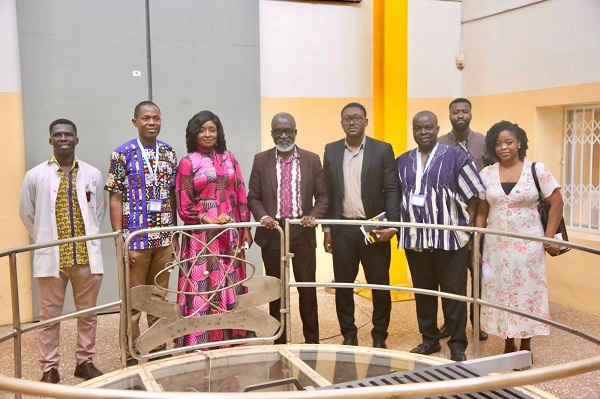
In a move signaling Ghana’s accelerating pursuit of nuclear energy and scientific advancement, Ambassador H.E. Matilda Aku Alomatu Osei-Agyeman, Ghana’s Ambassador to Austria, recently completed a high-level tour of the Ghana Atomic Energy Commission (GAEC). During the tour, the ambassador engaged with researchers and officials to explore opportunities for collaboration in nuclear science, technology, research, capacity building and knowledge transfer that could contribute to Ghana’s peaceful nuclear programme.
The visit formed part of Ghana’s broader diplomatic and scientific engagement with Austria, a country that hosts several international organizations, including the International Atomic Energy Agency (IAEA), which is headquartered in Vienna. During the tour, the ambassador engaged with researchers and officials to explore opportunities for collaboration in nuclear science, technology, research, capacity building and knowledge transfer that could contribute to Ghana’s peaceful nuclear programme.
Touring Ghana’s Atomic Frontline
The Ambassador visited facilities of the GAEC which included tours of facilities used for personnel dosimetry, radon and alpha spectrometry, and radioactive waste management. These facilities represent the practical application of nuclear science in areas critical to national development: radiation safety, environmental protection, and human health. The Ambassador’s engagement with officials highlighted GAEC’s role in supporting radiation protection measures and ensuring the safe application of nuclear technologies . It was an opportunity for Ghana to showcase its existing expertise while signaling its readiness to scale up capabilities.
Although Ghana does not yet operate a commercial nuclear power plant, it has built decades of experience in nuclear science through the Ghana Atomic Energy Commission, which was established in 1963. The Commission oversees nuclear research, radiation protection, biotechnology, agricultural applications, medical physics and industrial uses of nuclear technology.
At the centre of Ghana’s research infrastructure is the Ghana Research Reactor-1 (GHARR-1), a miniature neutron source reactor commissioned in 1994 at the National Nuclear Research Institute in Accra. The reactor is used for scientific research, neutron activation analysis, training and education, and has played a critical role in developing Ghana’s pool of nuclear scientists and engineers. Ghana also became the first country outside China to successfully convert its research reactor from highly enriched uranium to low-enriched uranium under an international non-proliferation initiative led by the IAEA.
This renewed push for nuclear power is a central pillar of Ghana’s development strategy. Chief of Staff Julius Debrah recently announced that the government is in the process of signing bilateral agreements for the construction of the 1,000MW plant and is also engaging partners for Small Modular Reactors (SMRs). The project is seen as vital for meeting the growing demands of the manufacturing and mining sectors, and for meeting Ghana’s climate commitments by reducing reliance on fossil fuels.
However, Ghana’s path to nuclear energy is not without hurdles. The country is currently navigating Phase Two of the IAEA Milestones Approach, which involves intensive site studies, public communication, and institutional development . A significant challenge is the incomplete regulatory framework. Reports indicate that crucial nuclear regulatory instruments have not been passed by Parliament in nearly a decade, creating a legal gap that could threaten the project’s timeline . The government has initiated a Nuclear Information, Communication, and Education campaign to build public awareness and support, a critical component for the project’s success.
Austria: A Gateway to Nuclear Expertise
Diplomatic ties between Ghana and Austria, established in 1960, have flourished across security, economic, and cultural spheres . At the Ghana-Austria Political Consultations held in Accra in February 2026, both nations renewed their commitment to a strategic partnership, with Austria describing Ghana as a “key democratic partner in promoting peace and stability” in West Africa.
Ghana’s security cooperation with Austria is robust. Economic and cultural ties are also deepening with Austria’s extended concessional financing for Ghanaian infrastructure and water supply projects. The two countries have maintained cordial diplomatic relations anchored in trade, development cooperation, education, culture and multilateral engagement. Austria has supported a number of development initiatives in Ghana through the Austrian Development Agency (ADA), particularly in healthcare, vocational training and humanitarian programmes.
Austria boasts world-class research institutions. Vienna’s new Marietta Blau Institute for Particle Physics, inaugurated in 2025, is Austria’s largest hub for particle physics research, contributing to major experiments at CERN . The Atominstitute of the Vienna University of Technology, which houses a working TRIGA research reactor, is used for training IAEA inspectors, providing a unique environment for practical education in radiation protection and nuclear safety. This expertise is directly transferable to Ghana’s ambitions.
Looking Ahead
Ambassador Osei-Agyeman’s visit to the nuclear research facilities is a practical step toward translating Ghana’s nuclear ambitions into reality. It represents Ghana’s strategy to leverage international cooperation to build internal capacity, manage safety risks, and ensure its nuclear program is built on a foundation of best practices.
As the nation prepares for the construction of its first nuclear plant, the partnership with Austria, rooted in decades of cooperation, is set to become even more critical. Success will depend not only on securing international technical support but also on resolving domestic challenges, particularly completing the legal and regulatory framework. The Ambassador’s tour is a clear signal that Ghana is committed to doing both.