
A recap of July’s Gheeks by the Fireside, in conversation with Dr. Akyana Britwum
G.H.Scientific · Gheeks by the Fireside · July 2026 edition
There is a story that comes up again and again when Ghanaian scientists talk about coming home: you train on world-class instruments abroad, you return full of ambition, and then you open the lab door and the equipment simply isn’t there. It’s such a familiar experience that when it surfaced in the chat during this month’s Gheeks by the Fireside, several people recognised it instantly.
For Dr. Akyana Britwum, Lecturer in Physics at KNUST, and Principal Investigator and co-founder of the Ghana Photonics and Optics Laboratory (GPOL), that gap between ambition and equipment is not a reason to give up. It’s the whole point and a motivator for what he does. Hosted by Dr. Hephzi Tagoe, this edition took as its theme “Science that builds: rethinking the role of African scientists,” and over the course of an hour Dr. Britwum made a compelling case that the constraint itself can be turned into a creative advantage.
From strongly correlated electrons to light
Dr. Britwum’s background is in solid state physics, the study of how materials are put together and why they behave the way they do. His PhD, supported by a UNESCO fellowship at the AGH University in Kraków, Poland, took him deep into the physics of complex materials. But when he returned to Ghana, he hit the familiar wall: the equipment needed to characterise materials is expensive, and often simply unavailable. For a while, that meant shipping samples out of the country and relying on collaborators to run them.
The turning point came through people rather than hardware. At KNUST he found others who wanted to push optics and photonics forward, and together they hosted a photonics and optics school on campus. One of those visits led to a proposal, and seed funding from SPIE (the International Society for Optics and Photonics) that allowed the lab to get off the ground. Today GPOL has students, postdocs, equipment, and a launch date: 22 September 2026.
What is photonics, and why does it matter here?
At its simplest, photonics is the science of generating, shaping and manipulating light so we can then read what light tells us when it bounces off, or passes through, matter. Your own eyes already do a version of this: light interacts with a table or a wall, and your eyes pick up the reflection. Scientific instruments just extract far more information from that interaction than the eye ever could.
Dr. Britwum’s key argument is that access to the right light-based tools directly determines the questions a scientist can even ask. A standard bright-field microscope, for instance, can’t resolve anything smaller than about 200 nanometres. Super-resolution microscopy can reach down to individual proteins — at a fraction of the roughly one-million-dollar price tag of a scanning electron microscope.
The consequences are practical and local: characterising Ghana’s herbal medicines at the molecular level, studying viruses of local concern, or developing new materials for solar panels and sensors. “We are not asking those questions,” he noted, “because we don’t have tools that can study the basic properties of these materials.” Build the tool, and you unlock the question.
Building instruments, not just buying them
Much of the evening was a tour of what “science that builds” looks like in practice. GPOL’s guiding principle is that a piece of equipment should be understood well enough to be rebuilt and improved, not just operated. A sample of what’s in the lab, or on the way:
The lab’s through-barrier Raman spectrometer, built in collaboration with the University of St Andrews, reads a material’s molecular “fingerprint” through packaging which makes it a powerful tool for spotting substandard or counterfeit medicines. An optical tweezer uses focused light to hold and probe a single cell, or even stretch a strand of DNA to measure the forces involved. And an incoming super-resolution microscope promises resolution down to around 20 nanometres, enough to question DNA.
Perhaps the most striking work is on cost. By 3D-printing lenses using transparent resin, the team aims to build a fully 3D-printed microscope, bringing the price down from one to three thousand dollars to around two to three hundred, with individual printed lenses costing less than a dollar. Building on the open-source OpenFlexure microscope (which runs on a Raspberry Pi), they are adapting the design for polarized-light microscopy to diagnose malaria without staining.
A community that’s hard to ignore
If there was a single thread running through the evening, it was that individual brilliance isn’t enough. Progress, Dr. Britwum suggested, comes from doing good science visibly and repeatedly, and from being generous with collaborators. Meeting the right partners, he said, is “a combination of serendipity and preparedness”. What is obvious is that, the more openly scientists share, the faster everyone moves. The long game is to build a body of work, and a public that understands and values it, “such that we cannot be ignored”.
It’s an ambitious vision, delivered with humour and candour. Asked what the future holds, he laughed: “Give me more money to build.” Behind the joke is a serious ask; for reduced barriers, for a science-literate public, and for the resources to do the kind of curiosity-driven science that answers the question of why, not only what for.
Missed it live? GPOL officially launches on 22 September 2026, and interested collaborators, students and interns were warmly invited to get in touch. abritwum.cos@knust.edu.gh
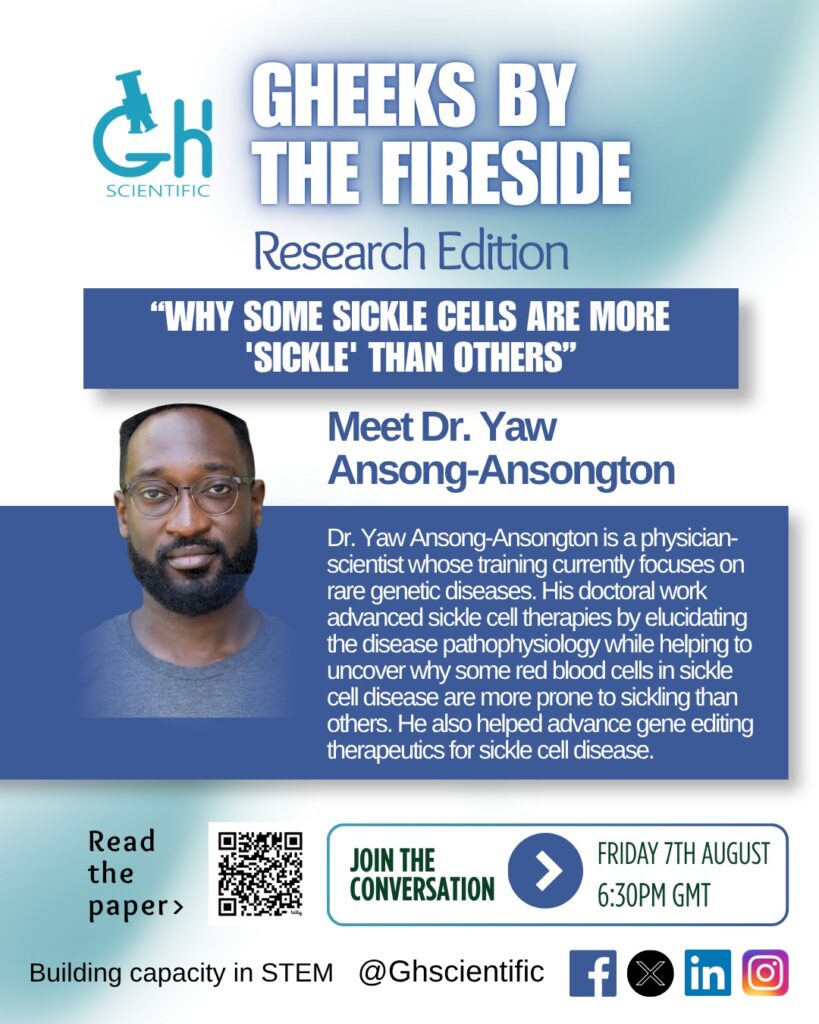
Coming up next: the Researchers’ Paper Discussion edition of Gheeks by the Fireside, led by Dr. Anthony Gyening-Yeboah, on Friday 7 August 2026 at 18:30 GMT.
Gheeks by the Fireside is GH Scientific’s monthly conversation series, part of our work building capacity in STEM and science communication across the continent. Not yet part of the STEMGheek community? [Join here →Join The STEMGheek Community – Fill out form
]