
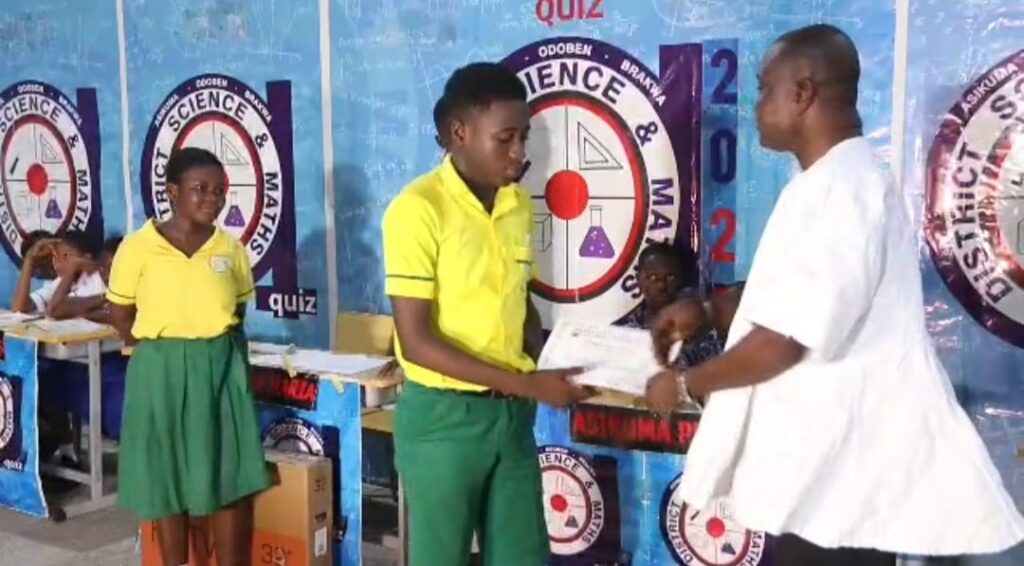
A renewed enthusiasm for Science, Technology, Engineering, and Mathematics (STEM) is sweeping through basic schools in the Asikuma-Odoben-Brakwa District following the successful conclusion of the maiden edition of the District Science and Maths Quiz. The competition, which brought together pupils from over fifteen public and private basic schools, was designed not only to test academic prowess but also to ignite a lifelong curiosity for scientific inquiry among young learners.
Speaking at the event, the Asikuma-Odoben-Brakwa Science and Maths Quiz Coordinator, Ato Kwamena, commended the participating schools for their impressive preparation and praised the initiative’s core mission.
“For too long, fear of mathematics and science has held many of our brilliant students back from reaching their full potential and pursuing higher education. This quiz is a powerful tool to cast out that perception. By bringing these subjects to life in a competitive yet fun environment, we are showing our children that they are more than capable of mastering them,” he said.
Held at the Asikuma District Assembly Hall, the event saw four finalist schools battle through preliminary rounds to compete in a tense, buzzer-based finale. The winners, Brakwa Christian International School, amassed 68 points to edge past Asikuma Ave Maria, Odoben Presbyterian Girls’, and Asikuma Presbyterian. The competition covered topics ranging from basic integrated science—including classification of living things, properties of matter, and simple machines—to mental arithmetic, fractions, and algebra suitable for the primary and junior high school curriculum.
Tackling STEM fear at the basic school level
Madam Cecilia Mensah, the District Director of Education, noted that the quiz was a direct response to declining performance in science and mathematics at the Basic Education Certificate Examination (BECE) in some circuits within the district. “Between 2019 and 2023, we observed that many pupils avoided elective science pathways in senior high school because they had developed a fear of the subjects early on. This competition aims to reverse that trend by making STEM fun, collaborative, and aspirational,” she said.
Pupils who participated expressed excitement about the format, which included visual rounds with diagrams of plant and animal cells, rapid-fire calculations, and a problem-solving relay where teams had to work together to crack a mathematical puzzle.
The District Science and Maths Quiz is part of a broader national push to strengthen STEM education at the pre-tertiary level. Across Ghana, similar competitions have become powerful tools for identifying talent and changing negative perceptions about science and mathematics.
Among basic schools, the National Science and Maths Quiz (NSMQ) for Basic Schools—a junior version of the renowned senior high school competition—has gained prominence, often organized regionally by the Ghana Education Service (GES) in collaboration with private institutions. Additionally, the STEMnovation Challenge for JHS students, which integrates project work with quiz elements, has been running successfully in the Greater Accra and Ashanti regions for the past three years.
At the secondary school level, the most prestigious academic competition remains the National Science and Maths Quiz (NSMQ), produced by Primetime Limited and aired on GTV and Joy News. Since its inception in 1993, the NSMQ has become a national spectacle, drawing millions of viewers as schools like Prempeh College, Presbyterian Boys’ Secondary School (PRESEC-Legon), and St. Augustine’s College battle for the crown.
These competitions have proven results. Research by the African Institute for Mathematical Sciences (AIMS) in 2022 indicated that students who participate in at least one national or regional science quiz are 40% more likely to select STEM electives in senior high school and pursue related tertiary programmes. Furthermore, alumni of the NSMQ and similar contests frequently cite the experience as a turning point in their academic confidence.
Shift in classroom dynamics and parent excitement
In Asikuma-Odoben-Brakwa, teachers are already reporting a shift in classroom dynamics. Mr. John Afful, a science tutor at Brakwa Anglican JHS, said: “Before the quiz, I had to force students to stay after school for remedial classes. Now, they are forming their own study groups and challenging each other with past questions. The competitive spirit has turned our science club from ten members to over sixty.” The District Directorate has announced plans to extend the quiz to include a project fair next year, where pupils will present simple innovations—such as water filtration devices and electrical circuit models—to complement the quiz format.
Parents, too, have embraced the initiative. Madam Janet Amankwah, whose daughter was part of the second-place team, noted: “My daughter used to say maths is for boys. After seeing female contestants win prizes today, she told me she wants to be a scientist. That is priceless.”
The success of the Asikuma-Odoben-Brakwa District Science and Maths Quiz adds to a growing body of evidence that academic competitions, when well-structured, can transform educational outcomes. As Ghana seeks to position itself as a regional hub for STEM innovation, grassroots efforts like this—coupled with national platforms like the NSMQ and JETS Olympiads—will be critical in building a pipeline of future engineers, doctors, data scientists, and innovators.
With the government’s recent investments in 10 new STEM model schools across the country, and the incorporation of coding and robotics into the new standards-based curriculum, the timing of district-level quizzes could not be more apt. For the pupils of Asikuma-Odoben-Brakwa, the final buzzer may have sounded, but for many, a lifelong journey into the world of science and mathematics has just begun.
Source: My Joy Online