

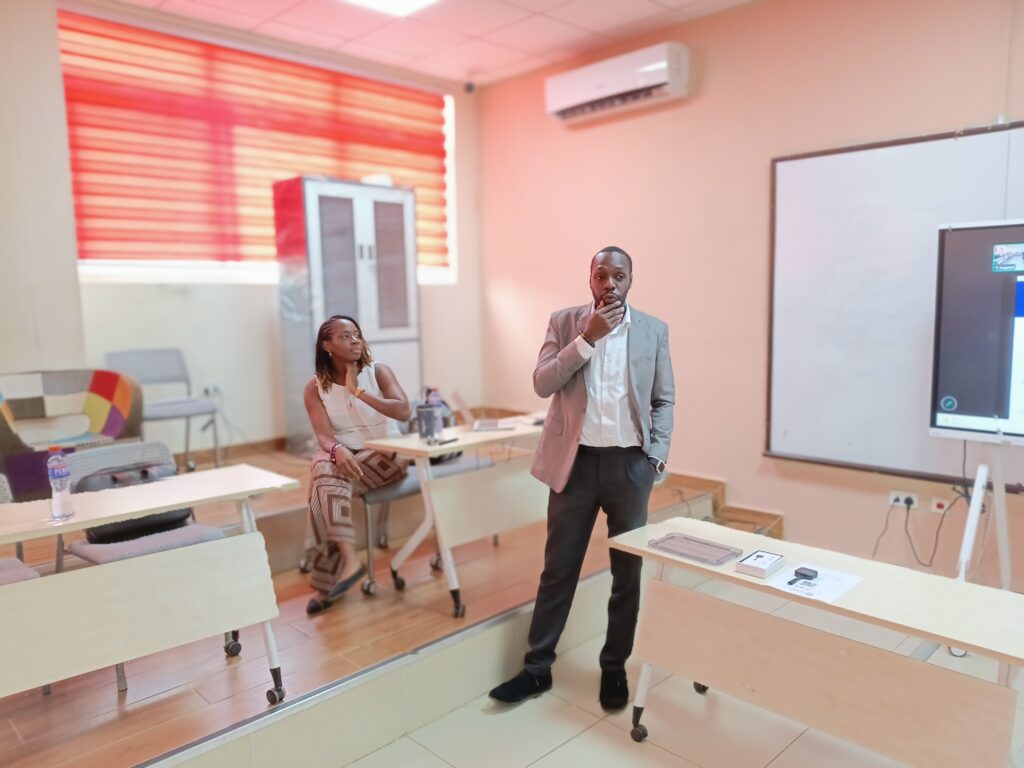
On the 22nd April, 2026, Academic City became a physical and virtual converging point for scientific researchers, students and professionals for a practical capacity-building workshop on Disease Models & Mechanisms in Research. Organized by G.H.Scientific with support from The Company of Biologists and in partnership with Academic City, WACCBIP, University of Ghana Medical School, and the Responsible Artificial Intelligence Lab (RAIL), the workshop was designed to seamlessly meld biology, mathematics, engineering and computing to show that modern disease reseach is deeply interconnected.
Why Disease Models Matter
The keynote speaker, Dr Thomas Tagoe set the ball rolling by eplaining a simple satement: Scientists can not practically experiment directly on human so they build models to represent them. After numerous tries and errors, they then move to humans but in a controlled environment.
Dr Tagoe focused on animal modelling, but the discussion went beyond that He explained for a model to be scientifically valuable, it has to closesly replicate the disease in structure, behaviour and response to treatment. Without that, a model becomes misleading rather than useful. However, it should be noted that there are some diseases that do not follow this pattern.
He also reiterated that one of the crucial ethical frameworks in modern disease research: the 3Rs-Replacement, Reduction and Refinement. This means that models are refined and animals are replaced where possible to reduce the pain and hurt meted out to the animals. It was clear that science has progressed steadily and has increased responsibility.
When Malaria Becomes a Live Simulation
Francis Dzabeng’s virtual session brought to live the mathematical modelling using malaria as a real life example. Paarticipants were introduced to mathematical and compartmental modelling with malaria as a case study. Using simple codes and graphs, Francis showed how populations shift, infections spread and outcomes change over time, which determine the decisions to be made.This showed how mathematics is not only for academic but can be used in the sciences to forecast global health outcomes.
Biosensors: When the Human Body Become a Data Source
Dr Felix Ansah’s session turned the focus inside; frrom populations to the human body itself.He introduced biosensors as tools that translate biological changes into electrical signals that can be meausreed and analyzed to diagonse diseases. He showwed what these biosensors look like and explained how they work. Using Ohm’s law, Dr Felix explained how differences in resistance, voltage and current are used to interpret changes in the human body. The body becomes a myriad of systems and the biosensors become the translators, making disease detection a conversation between biology and electricity.
Computational Modelling: Structuring Scientific Thinking
Musa’s session pulled everything together with a broader computational modelling. He introduced four ways researchers think about systems; descriptive, explanatory, predictive and prescriptive. He mentioned that descriptive modelling focuses on showing what is happening in a system, while explanatory modelling helps to understand why it is happening. Predictive modelling is used to forecast future outcomes based on available data, and prescriptive modelling suggests possible actions to improve results. He also revisited compartmental modelling, drawing the connection back to previous discussions on the spread of diseases.
A Step Toward Stronger Research Capacity
The workshop made on thing clear: disease modelling is not confined to theory or specialized laboratories. It is gradually becoming a practical toolkit that is a product of the interconnection between biology, mathematics, computing and engineering. It also serves as a bridge to help researchers create a close knit community with a plethora of usable skills to help each other out when the need arises. In this ear of rapidly mutating diseases and overwhelming data, workshops like these are cultivating a generation of researchers who can model solutions before the crises arises.