
Instead of asking, “How old is this patient?” doctors may one day be able to ask, “What is your brain age?”
A growing area of neuroscience suggests that the brain itself may have its own age. Dr Raphael B. Takyi, a Ghanaian-trained physician and doctoral researcher at Université Paris Cité, studies how brain changes after a stroke. During a conversation about his recent work, he explained that “Biological ageing basically tells us how well you’ve lived, whereas your age tells you how long you’ve lived.” That distinction raises a compelling question: could the biological age of the brain help explain why recovery differs so widely between patients?
The age your birthday cannot show
A stroke happens when blood flow to part of the brain is blocked or when a blood vessel ruptures. Without enough oxygen and nutrients, brain cells begin to die. Depending on the area affected, a person may lose strength in an arm or leg, struggle to speak, develop facial weakness or experience changes in vision and coordination.
But stroke is not always limited to one visible area of damage. The brain is a deeply connected organ and an injury in one part can disrupt networks elsewhere, including pathways involved in movement, sensation and balance.
This is where brain age may offer a different way of looking at recovery.
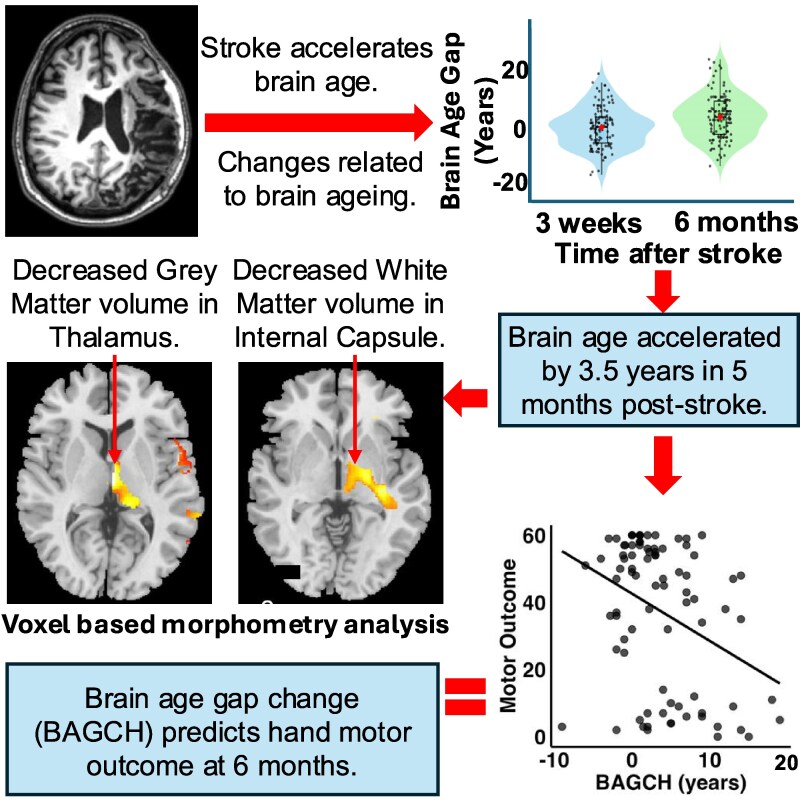
Brain age is an estimate of how old the brain appears from its structure. Researchers calculate it by comparing patterns in a person’s MRI scan with those found in healthy people of different ages. The difference between this estimate and someone’s actual age is known as the brain age gap.
A positive gap means the brain appears older than expected; a negative gap means it appears younger. A 60-year-old, for example, may have a brain that more closely resembles that of someone who is 70 while another 60-year-old may have a brain that appears closer to 50. Their birthdays are the same, but the brains facing the work of recovery may be quite different.
The months after the emergency
Takyi and his colleagues examined brain scans from 114 people recovering from stroke. The patients had weakness affecting an arm or hand, and their brains were scanned shortly after the stroke and again several months later.
Over that period, the participants’ brain age gap increased by an average of 3.62 years. This did not mean they had literally aged by almost four years. Rather, their scans showed structural changes that made their brains appear older than expected. These changes extended beyond the original site of the stroke, suggesting that the effects of stroke can continue across connected brain regions after the immediate emergency has passed. Those whose brains appeared to age faster also tended to have poorer recovery of arm and hand function, including grip strength and dexterity.
Recovery is measured in ordinary things
For anyone who has watched a loved one recover from stroke, this is not an abstract finding. Hand and arm function affect almost everything: eating, bathing, writing, dressing, using a phone, working, cooking or holding a grandchild. Losing these abilities can change a person’s independence almost overnight.
The research also challenges a common assumption about age and recovery.
In many settings, older patients may be expected to recover less well simply because of their age. But brain age complicates that story. Two people may both be 70, but their brains may not carry the same biological history. Blood pressure, diabetes, smoking, physical activity, genetics education, nutrition and previous illness may all leave different marks over time. Brain age may reflect some of this accumulated wear. It may also offer clues about what scientists call brain reserve: the brain’s capacity to withstand injury and adapt after damage.
That does not make brain age a verdict. It cannot yet tell a patient exactly how much movement will return or how long recovery will take. It is still an emerging research tool rather than a routine clinical test.
When age becomes a judgement
This is important for rehabilitation particularly in countries like Ghana, where stroke recovery can place a heavy burden on families and access to specialist rehabilitation is often uneven. Families may be left wondering how much improvement is possible, how long therapy should continue, and whether progress is still worth hoping for. Brain age will not answer all those questions yet. More research is needed before it can guide everyday care. But it could eventually add another layer to clinical assessments and help make rehabilitation decisions more personalised.
Instead of asking only, “How old is this patient?” doctors may one day be able to ask, “How resilient is this brain?”
That shift could help clinicians avoid treating age as destiny. It could also help families understand why two people with similar strokes can travel very different recovery journeys.
Ageing is not only counted in birthdays. It is also written, quietly and unevenly, into the brain over time.
And after stroke, that hidden age may shape the long journey back to everyday life.
Paper reference: https://pmc.ncbi.nlm.nih.gov/articles/PMC12399367/