
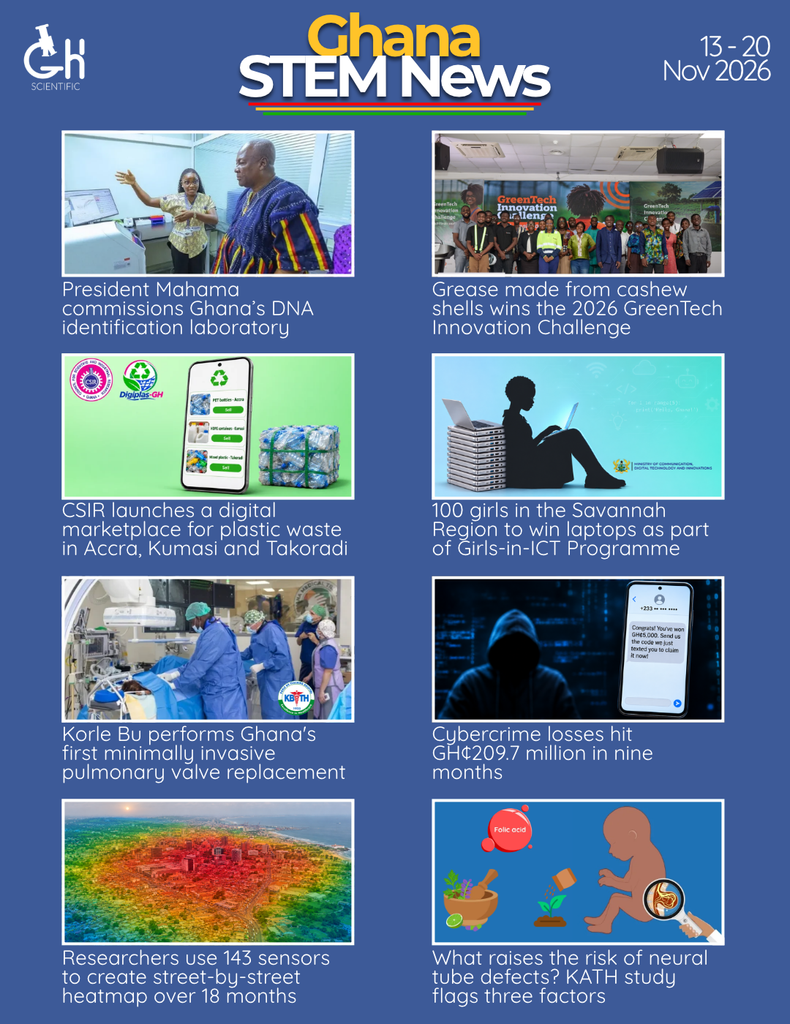
Ghana built its own answers this week of Ghana STEM News. A national DNA laboratory and new mRNA vaccine labs opened at Noguchi, a home-grown vaccine got a 2027 date, and a small Accra AI lab became a global voice on biosecurity. There were also hard numbers on mercury, drug resistance and cybercrime that every Ghanaian should know. Korle Bu also carried out the country’s first keyhole-style heart valve replacement. Here are the 12 Ghana STEM stories that mattered most, plus 2 new Ghana studies, each with a plain-language summary and why it matters.
1. Ghana opens its own national DNA identification laboratory
On 18 November, President John Mahama commissioned the National Human Identification Laboratory at the University of Ghana’s Noguchi Memorial Institute for Medical Research (NMIMR). The lab will run DNA tests for criminal investigations, identifying disaster victims, and paternity and inheritance disputes. It was built after the August 2025 military helicopter crash, when remains had to be sent to South Africa for DNA testing.
Why it matters: DNA analysis is now a home-grown service, not an import. Families and investigators should get answers faster and at lower cost. It also gives Ghanaian geneticists a national facility to train in and build research on.
2. mRNA vaccine labs open, and Ghana’s first locally made vaccine is due in early 2027
At the same event, new mRNA and protein vaccine research labs opened at Noguchi. The President said Ghana is one of just five African countries working with mRNA technology. Five Ghanaian scientists from Noguchi, WACCBIP, KCCR and UHAS trained in Brussels and Accra to run the lab. Separately, the National Vaccine Institute said Ghana’s first locally manufactured vaccine, a tetanus-diphtheria (Td) vaccine, is expected by the first quarter of 2027, with Atlantic Life Sciences.
Why it matters: The COVID-19 pandemic showed how far back Africa sits in the vaccine queue. mRNA is the same flexible platform behind the fastest COVID-19 vaccines, and it is now being explored for cancer vaccines. A plan to move from fill-and-finish to full end-to-end manufacturing, with a biomanufacturing training consortium by end-2027, means new careers for Ghanaian scientists.
Sources: GNA, 3News, Citi Newsroom
3. An Accra AI lab is sounding the global alarm on AI-designed bioweapons
A Rest of World feature (16 November) profiled MinoHealth AI Labs in Accra, founded by Darlington Akogo. In 2024 the team removed the safety guardrails from its own drug-discovery AI as a test. The model designed 1,020 proteins and 5,000 small molecules that toxicity software scored as likely toxic. None were ever made. The study has since been discussed within Interpol, and Akogo is calling for mandatory screening of DNA synthesis orders and a UN working group on AI risk.
Why it matters: A 20-person Ghanaian team is shaping a global safety debate, not just following it. It is also a clear lesson in “dual use”: the same AI that can find new medicines can be misused. MinoHealth’s main work remains health, including an EU-funded consortium on mpox and malaria antibodies.
Source: Rest of World
4. Up to 62 tonnes of illicit mercury enter Ghana every year
At a two-day forum in Accra (15 November), stakeholders said 42.5 to 62 tonnes of mercury enter Ghana each year through illicit channels, mostly for small-scale gold mining (galamsey). Prof. Daniel Nukpezah of the University of Ghana explained that in rivers, microbes turn mercury into methylmercury, which builds up in fish and moves up the food chain. A GNA feature (17 November) noted early findings of mercury in some cassava and cocoa samples, but stressed these are preliminary and do not show the food was unsafe.
Why it matters: This is “biomagnification” in action: small amounts in water become larger amounts in the fish we eat. Ghana has signed the Minamata Convention on Mercury, but enforcement is the gap. Better testing of rivers, fish and crops is what turns fear into evidence.
Sources: GNA, GNA feature
5. Drug-resistant infections could cost Ghana $435 million a year
For World AMR Awareness Week (18–24 November), the Pharmaceutical Society of Ghana warned that drug-resistant bacterial infections could cost Ghana about US$435 million a year between 2024 and 2030. That includes about US$105 million in healthcare-provider costs and US$97 million paid directly by patients and families. The PSGH urged better funding of Ghana’s National Action Plan on AMR and told the public to stop self-medicating.
Why it matters: Antimicrobial resistance (AMR) happens when bacteria, viruses, fungi and parasites evolve to survive the medicines meant to kill them. Misused antibiotics in people, livestock and fish farms all feed it. Surgery, cancer care and childbirth all depend on antibiotics that work.
Source: GNA
6. A grease made from cashew shells wins the 2026 GreenTech Innovation Challenge
Pure Lube Limited won the 2026 GreenTech Innovation Challenge and GH¢150,000. The start-up makes biodegradable grease from cashew nutshell liquid, a by-product of cashew processing, as an alternative to petroleum lubricants. The team says it stays stable above 250 °C. The challenge, run by Fidelity Bank Ghana and the Innohub Foundation, drew more than 350 applications. Fuscham Greentech, Hydrohope, McNob Empire and Kinecticks Robotics were the other winners.
Why it matters: This is green chemistry in practice: turning agricultural waste into a useful product. It also fits the week’s wider push for local cashew processing, adding value in Ghana instead of exporting raw nuts.
Source: GNA
7. Cybercrime losses hit GH¢209.7 million in nine months
At a cybersecurity industry forum in Accra (15 November), the Cyber Security Authority reported GH¢209.7 million in losses from 4,938 incidents between January and September 2026. That is about nine times the losses reported for all of 2025. CSA Director-General Dr Divine Selase Agbeti called for security to be built into digital systems from the design stage.
Why it matters: As more of daily life moves onto mobile money and online services, digital literacy is personal safety. Most losses come from fraud and impersonation, which means the human is the weakest link. It also signals a growing need for trained cybersecurity professionals.
Source: GNA
8. CSIR launches a digital marketplace for plastic waste
The CSIR Institute of Industrial Research brought plastic collectors, recyclers and manufacturers together (19 November) to introduce Digiplas-GH. It is a digital marketplace that links buyers and sellers of recyclable plastic. The project runs under the UN Environment Programme’s Basel Convention, with pilots in Accra, Kumasi and Takoradi. CSIR scientist Dr Latifatu Mohammed said households could eventually sort and sell clean plastic on the platform.
Why it matters: Plastic chokes drains and contributes to flooding in Ghana’s cities. Giving waste a clear market price is one of the best ways to keep it out of the sea. This is a circular-economy idea built by Ghanaian scientists.
Source: GNA
9. 100 girls in the Savannah Region to win laptops and an Accra tech tour
The Ministry of Communication, Digital Technology and Innovations said the 100 best performers in the National Girls-in-ICT Programme in the Savannah Region will receive laptops and a one-week tech tour of Accra. Deputy Minister Mohammed Adams Sukparu announced the rewards in the West Gonja Municipality. The girls will also be mentored by women working in ICT and telecoms companies.
Why it matters: Women remain under-represented in tech, and the gap is widest outside big cities. Seeing women in real tech jobs, and owning a laptop to keep practising, can turn a short course into a career.
Source: TechAfrica News
10. AI in the classroom: use it, but use it wisely
Two messages on AI and learning landed this week. At the British Council Partners School Leaders Forum in Accra (18 November), Country Director Nii Doodo Dodoo said the question is not whether AI should be used in schools, but how to use it responsibly while protecting children’s privacy and safety. On 20 November, USTED Vice-Chancellor Prof. Frederick K. Sarfo warned students that over-relying on AI can blunt critical thinking and memory.
Why it matters: Ghana is adding AI to the basic school curriculum and planning a National AI Centre. The real test is whether students learn to think with AI rather than let it think for them. Clear school policies now will shape how a whole generation learns.
Sources: GNA, Ghanaian Times
11. Korle Bu performs Ghana’s first minimally invasive pulmonary valve replacement
The National Cardiothoracic Centre (NCTC) at Korle Bu Teaching Hospital has carried out Ghana’s first transcatheter pulmonary valve replacement. The patient was a 14-year-old girl with severe pulmonary valve regurgitation, a leaky valve that lets blood flow back into the heart. In a one-hour procedure, the team guided a Harmony Valve through a blood vessel in her thigh up to the heart, with no need to open the chest. She is recovering well and the valve is working well. The work was done with Germany’s Kinderherzen International and the Gerald Asamoah Foundation, using the Centre’s newly upgraded catheterisation lab.
Why it matters: Open-heart surgery means a large chest wound and a long recovery. Going in through a blood vessel is gentler and usually faster to recover from. Children treated under the partnership received care at no cost, supported by the Ghana Medical Trust Fund, and PDA and ASD hole-in-the-heart closures are planned next. Each new procedure done at home is one fewer family forced to seek treatment abroad.
Source: Korle Bu Teaching Hospital (official Facebook statement)
12. Three early-career scientists win bioinformatics training seed grants
After a Train-the-Trainer workshop held from 9 to 13 November by Noguchi (NMIMR) and the University of Cambridge’s Centre for Research Informatics Training, three participants won seed grants totalling £2,500. Tosin Yetunde Senbadejo (WACCBIP, University of Ghana, £1,000) will teach command-line skills to microbiology undergraduates. Yahaya Sumara Sulley (University for Development Studies, £1,000) will run a bioinformatics training lab using peer mentoring. Alex Awentirim Akayiri (University of Ghana, £500) will train health workers to interpret antimicrobial-resistance data. The workshop was funded by the Mastercard Foundation and a University of Cambridge climate-resilience fund.
Why it matters: Bioinformatics is how scientists make sense of DNA data. It is the skill behind outbreak tracking, drug-resistance surveillance and the new DNA lab in Story 1. Training trainers spreads those skills to students and hospitals far beyond Accra.
Source: The Confident Scientist
New Ghana research worth knowing
Two newly published studies led by or based in Ghana, explained in plain language.
Study 1. Mapping Accra’s heat, street by street
Researchers placed small temperature sensors at 143 sites across Greater Accra for 18 months. They combined the readings with satellite and land-use data to build the first ground-based temperature maps for a major sub-Saharan African city, at 50 m × 50 m resolution. Daytime heat depended mostly on the sun’s angle, while night-time heat depended on land use and distance from the coast. Average temperatures were 28.6 °C in the Harmattan season and 26.4 °C outside it, and peri-urban areas were generally cooler than built-up and commercial zones.
Why it matters: Heat does not hit everyone equally. Neighbourhoods that stay hot at night give bodies no chance to recover, which raises health risks for older people, babies and outdoor workers. Maps this detailed show city planners where shade, trees and cooling are needed most.
Source: Doyle et al., Environmental Research: Health (published online 17 November 2026)
Study 2. What raises the risk of neural tube defects in babies?
Neural tube defects (NTDs) happen when the baby’s brain or spinal cord does not close properly in the first weeks of pregnancy. A case-control study at Komfo Anokye Teaching Hospital, Kumasi, compared 97 infants with NTDs to 196 without, admitted between September 2024 and June 2025. Most affected infants (83.5%) had spina bifida. Three factors stood out: starting folic acid late, using herbal medicine around the time of conception (about 4 times the odds), and exposure to agrochemicals or pesticides (about 3.7 times the odds).
Why it matters: The neural tube closes before many women know they are pregnant, so folic acid works best when taken before conception. The links to herbal medicines and farm chemicals point to clear public-health messages for women planning a pregnancy, especially in farming communities.
Source: Ocran et al., SAGE Open Pediatrics (October 2026)
The big picture
This week’s theme was building capacity at home: DNA tests no longer sent abroad, vaccines made locally, advanced heart procedures done at Korle Bu, new bioinformatics trainers, and Ghanaian scientists leading global conversations. The warning signs on mercury, drug resistance and cybercrime show why that capacity matters.
Which story surprised you most? Tell us in the comments, share this round-up with a science lover, and come back next Friday for more Ghana STEM news.