
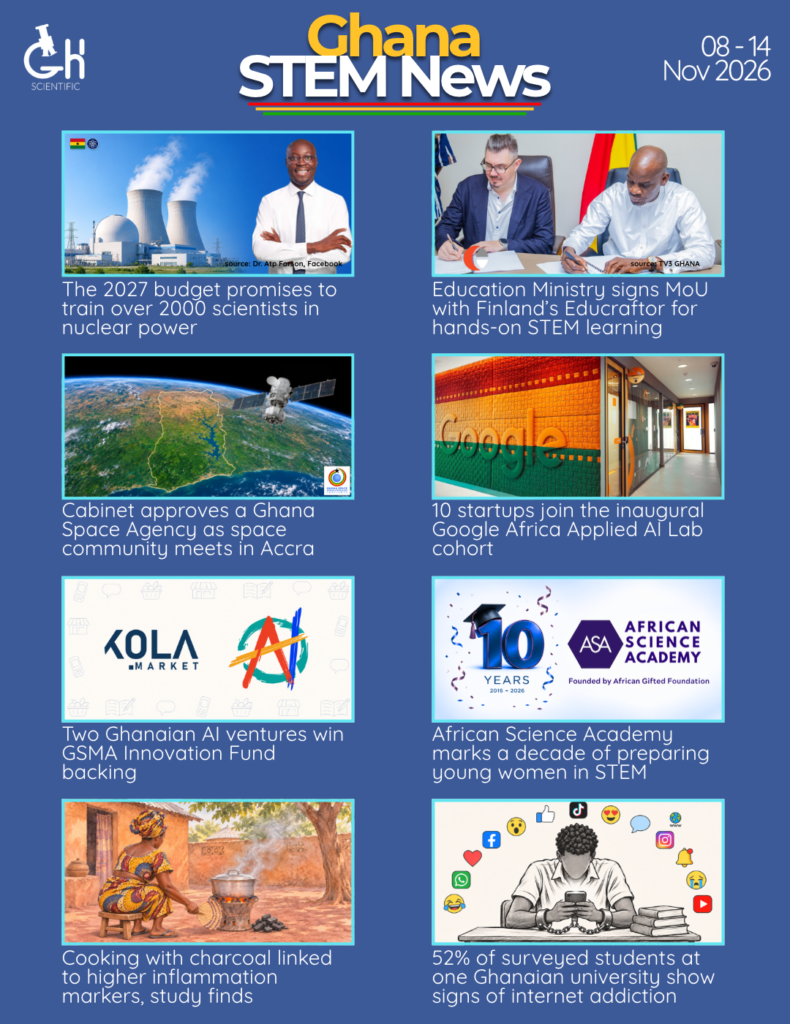
Your Friday catch-up on the science, technology and education stories shaping Ghana, explained for everyone, not just the lab coats.
It was a big week for Ghana STEM news. The 2027 Budget put nuclear skills on the agenda, Cabinet cleared a Ghana Space Agency, and Ghanaian AI start-ups won international backing. Here are six news stories, plus four newly published Ghana studies on air pollution, cooking fuel, farm soils and student internet use, each with a plain-language summary and a note on why it matters.
The 2027 Budget promises to train over 2,000 scientists for nuclear power
Presenting the 2027 Budget on 12 November, Finance Minister Dr Cassiel Ato Forson said government will train more than 2,000 scientists for Ghana’s nuclear power programme. He said the preparations (site suitability, technology selection, environmental assessment, financing, licensing and emergency planning) must be complete before construction contracts are signed, with international partners supplying technology and financing.
WHY IT MATTERS: A power plant is only as safe as the people running it. Training reactor operators, engineers, chemists and regulators years ahead creates skilled STEM jobs and shows that Ghana is treating nuclear power as a long-term national project, like the Akosombo Dam in its day.
Source: GBC Ghana Online, 12 November.
Cabinet approves a Ghana Space Agency
Cabinet has approved establishing a Ghana Space Agency, and the draft law is now with the Attorney General’s Department, the Ministry of Environment, Science, Technology and Innovation said. The agency would coordinate space activities, support research and encourage public-private partnerships. The existing Ghana Space Science and Technology Institute would be upgraded into the new agency.
WHY IT MATTERS: Satellites help with farming, weather forecasting, mapping and tracking illegal mining. A dedicated agency gives scientists, start-ups and students one clear home for space work, and builds local skills instead of relying on foreign models for decisions about Ghana’s land.
Source: The Herald Ghana, 11 November.
Education Ministry teams up with Finland’s Educraftor on STEM teaching
The Ministry of Education has signed a Memorandum of Understanding with Finnish education organisation Educraftor to strengthen STEM education. The partnership will support curricula that meet international standards, and promote student-centred, project-based learning so pupils apply science and maths to real problems.
WHY IT MATTERS: Learning by doing, such as building, testing and solving, tends to stick better than memorising. If it reaches classrooms, this could help pupils gain the problem-solving skills that tech-driven jobs now demand.
Source: Citi Newsroom, 6 November.
Google’s Accra AI lab names its first cohort, but no Ghanaian start-up is on the list
The Google Africa Applied AI Lab, based at the Accra AI Community Centre, announced ten start-ups from across Africa. According to 3News’s start-up round-up, no Ghanaian company appears on the published list. The cohort will return to Accra for a demo day in December. On a brighter note, Gbe La, led by Ho Technical University graduate Delali Hannah Vordoagu, won the Accra round of the 2026 MoMo Fintech Lab.
WHY IT MATTERS: Ghana is hosting a major AI programme, yet Ghanaian founders did not make this first list. It is a nudge for local builders to apply for the next round, and for universities and hubs to support them.
Source: 3News Startup Roundup, 12 November.
Two Ghanaian AI ventures win GSMA Innovation Fund backing
Kola Market, which builds AI sales tools for small businesses over WhatsApp, SMS and voice in local languages, and Metaschool AI, which delivers curriculum-aligned tutoring on feature phones through USSD and SMS, are among the grantees of the GSMA AI Innovation Fund. The fund drew 625 applicants.
WHY IT MATTERS: Both start-ups are designed for people with basic phones and limited data. Ghanaian ideas winning international support shows that practical, low-bandwidth AI is a real strength, not a second-best option.
Source: InsideAI News, 13 November.
African Science Academy marks ten years in Tema
The African Science Academy, Africa’s first post-secondary STEM academy for gifted girls, is celebrating a decade since opening in Tema in 2016. It runs an intensive one-year pre-university Advanced Level programme in maths and science for young women from across the continent.
WHY IT MATTERS: Girls remain under-represented in many STEM fields. Ten years of graduates heading to university shows what targeted opportunity can do, and gives Ghana a home-grown model other schools can learn from.
Sources: NigeriaMag, 13 November; African Science Academy.
Accra’s air is changing: cooking-fire smoke is falling, but waste burning is rising
Researchers collected more than 600 weekly samples of fine particle pollution (PM2.5) at 146 sites across Accra between April 2019 and June 2020, then analysed their chemical make-up to trace where the pollution comes from. During the dusty Harmattan season, natural dust made up 52 to 68 percent of the measured elemental mass. Outside Harmattan, the mix included biomass burning, traffic and road dust, solid and electronic waste burning, construction dust, crustal dust and sea salt. Compared with a decade earlier at four older monitoring sites, the share from biomass burning (wood and charcoal smoke) fell by about 16 percent, while the share from burning solid and electronic waste rose significantly, by a mean difference of 23 percent. Household biomass use is still one of the biggest sources.
WHY IT MATTERS: PM2.5 particles are small enough to reach deep into the lungs. You cannot fix air pollution without knowing where it comes from, and this study shows the sources are shifting as the city grows. The authors say this calls for policies aimed at specific sources and sectors, such as cleaner household energy and better waste management.
Source: Lange, Specht, Arku and colleagues, Environmental Health Perspectives 134(7):865-877, doi:10.1021/EHP.6c00323.
Scrapyard soils in Wa hold metals, but peppers grown in them do not tell a simple story
Scrap metal recycling is common in Ghana, and scientists wanted to know whether it leaves toxic elements in the soil and in crops. They took soil from five scrapyards in Wa plus a reference site, then grew pepper plants in 18 pots for three months. Soil arsenic ranged from about 14 to 42 mg/kg and soil lead reached about 131 mg/kg at the highest. Iron built up strongly in roots. Lead in the peppers themselves ranged from 0.07 to 4.4 mg/kg across the scrapyard soils, compared with 4.4 mg/kg in the control. Metal levels in the fruit did not consistently follow the levels in the soil.
WHY IT MATTERS: The results are descriptive and small-scale, so they neither prove that scrapyard-grown peppers are unsafe nor that they are safe. What they show is that contaminated land and contaminated food do not always line up neatly. The authors call for field trials and proper exposure assessments before anyone farms on, or draws conclusions about, scrapyard soil.
Source: Sebiawu, Mensah, Amankwah and Richard, Environmental Monitoring and Assessment 198(12):1291, doi:10.1007/s10661-026-16148-6.
In Tamale, women who cook with charcoal show signs of higher inflammation markers
Women in Ghana carry the heaviest exposure to smoke from cooking fuels. This study compared 100 adult women in the Dungu and Sawaba communities of Tamale: 40 who mainly cooked with LPG or electricity, 27 with charcoal and 33 with firewood. In raw comparisons, firewood users had lower thyroid hormone levels (TSH and fT3) than LPG or electricity users, but those links faded after adjusting for other factors. What remained was that higher white blood cell and neutrophil counts, both immune cells, were linked to higher odds of using charcoal.
WHY IT MATTERS: Raised immune cell counts may hint at low-level inflammation from breathing smoke, though the authors stress this is an early signal from a small, single-point-in-time study and needs larger, longer follow-up. It adds to the case that clean cooking is a health issue for women, not only an energy or climate one.
Source: Banyeh and colleagues, FASEB BioAdvances 8(11):e70164, doi:10.1096/fba.2026-00269.
More than half of surveyed Ghanaian university students show signs of internet addiction
Researchers surveyed 850 undergraduates, randomly selected from six schools of one Ghanaian university. About 52 percent showed internet addiction and 54 percent showed high internet use. Pharmacy students had nearly three times the odds of internet addiction compared with medical students (adjusted odds ratio 2.98). Final-year (level 400) students and single students had lower risk than first-year (level 100) students and married students. Parents’ education and employment were also linked to risk.
WHY IT MATTERS: Being online is part of study and life, so the question is when use becomes harmful. The pattern differs by school and year, which suggests support should too. The authors recommend digital literacy programmes matched to academic level and school type, plus workshops and counselling. As a survey, it shows links, not causes.
Source: Adedia, Konlan and colleagues, doi:10.1007/s44192-026-00564-8.
The bottom line
Ghana’s science story this week was about preparation: for nuclear power, for space, and for a start-up scene building AI that works for everyone. The new research adds a reminder that the air we breathe, the fuel we cook with and the soil we farm on are science stories too. Which story matters most to you? Share this round-up with someone who loves science, and come back next Friday for more.