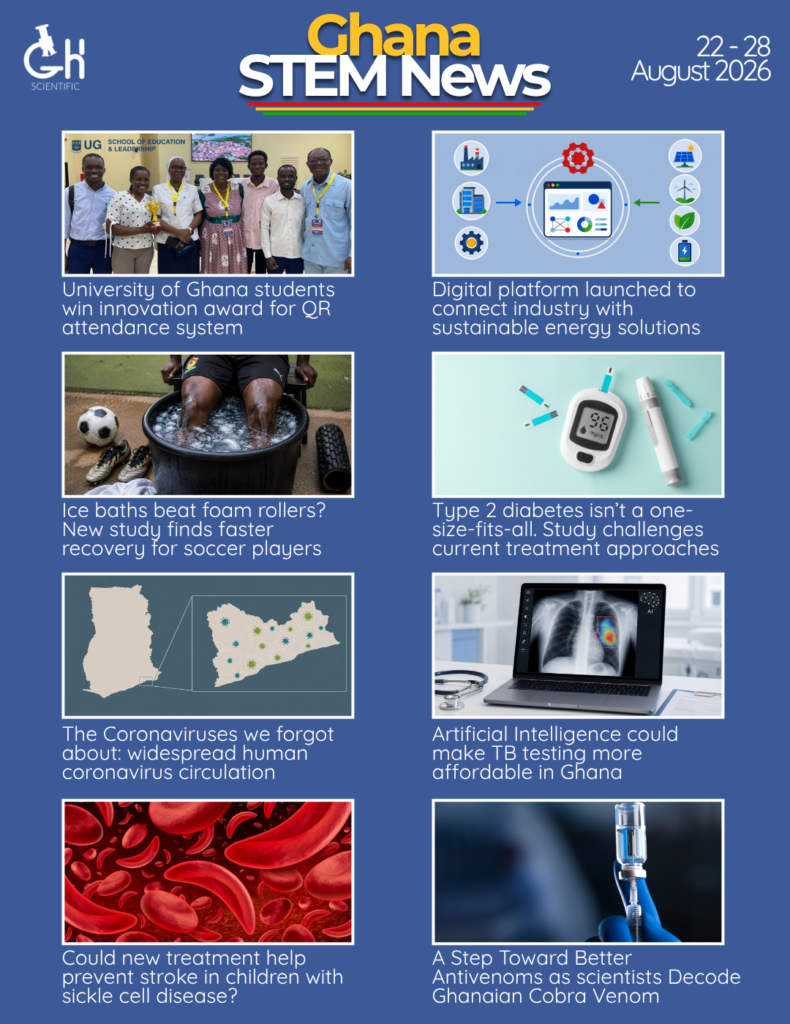

1. Decoding a Deadly Bite: Ghanaian Scientists Map the Venom of the Forest Cobra
Source: Journal of Chromatography B (via PubMed)
Link: https://pubmed.ncbi.nlm.nih.gov/42664546/
Summary: Researchers analysed the venom of the forest cobra (Naja melanoleuca) collected in Ghana and found it contains a complex mixture of proteins, with smaller toxins making up a large proportion of the venom. The study also confirmed the venom’s high toxicity and provides one of the first detailed protein profiles of this species from Ghana.
Why It Matters: Snakebite remains a significant health threat in many parts of Ghana. Understanding exactly what is in the venom is a critical step toward developing more effective locally relevant antivenoms and improving treatment outcomes.
2. Can a New Treatment Help Prevent Strokes in Children with Sickle Cell Disease?
Source: American Journal of Hematology (PubMed)
Link: https://pubmed.ncbi.nlm.nih.gov/42665434/
Summary: A major international clinical trial, HOPE Kids 2, found that voxelotor significantly reduced abnormal cerebral blood flow velocities in children with sickle cell disease, a key indicator of stroke risk. The study involved 236 children, mostly from sub-Saharan Africa, including participants from Ghana. However, the trial was halted after a higher number of deaths were observed in the voxelotor group, although investigators reported that the deaths were not considered related to the drug. [HOPE Kids…s – PubMed]
Why It Matters: Stroke is one of the most serious complications of sickle cell disease in children. These results highlight both the promise and the challenges of developing safer, more effective treatments for African children who bear a large share of the global sickle cell burden.
3. How Artificial Intelligence Could Make Tuberculosis Testing More Affordable in Ghana
Source: PLOS One (via PubMed)
Link: https://pubmed.ncbi.nlm.nih.gov/42658850/
Summary: A new Ghanaian study found that AI-powered chest X-ray screening could identify people who need tuberculosis testing more efficiently than current screening methods. Using data from 701 patients across 23 health facilities, researchers showed that the AI approach reduced screening costs while improving health outcomes. The model could save nearly US$10,000 per 701 people screened and deliver better overall health benefits.
Why It Matters: Tuberculosis remains a major public health challenge, and diagnostic tests can be expensive. This study suggests that AI could help Ghana find more TB cases sooner while making better use of limited healthcare resources.
4. Digital Platform Launched to Connect Industry with Sustainable Energy Solutions
Source: Ghana News Agency
Link: https://gna.org.gh/science/
Summary: The Association of Ghana Industries (AGI) launched a digital platform that links businesses with sustainable energy providers and services. The platform is designed to help companies identify energy-efficient technologies and financing opportunities. It also aims to support Ghana’s transition toward cleaner industrial operations.
Why It Matters: Reducing energy costs and emissions is increasingly important for businesses. Digital tools that promote energy efficiency can improve competitiveness while supporting environmental goals.
5. The Coronaviruses We Forgot About: Study Finds Widespread Human Coronavirus Circulation Across Ghana
Source: Frontiers in Epidemiology (via PubMed)
Link: https://pubmed.ncbi.nlm.nih.gov/42639089/
Summary: Researchers surveyed 1,000 people in rural and urban Ghana and found ongoing circulation of several human coronaviruses, including SARS-CoV-2. The study detected evidence of widespread past exposure and active infections, showing that multiple coronavirus strains continue to circulate in communities across the country.
Why It Matters: COVID-19 may no longer dominate headlines, but coronaviruses remain an important public health concern. Continued surveillance can help Ghana detect emerging respiratory threats early and strengthen outbreak preparedness.
6. Not All Type 2 Diabetes Is the Same: Ghana-Linked Study Challenges Current Treatment Approaches
Source: EurekAlert! / Diabetologia
Link: https://pubmed.ncbi.nlm.nih.gov/42633598/
Summary: A new study led by researchers from Amsterdam UMC and the University of Ghana has found that type 2 diabetes operates differently depending on a person’s body weight. Using data from more than 3,300 African adults from Ghana, Nigeria, Kenya, and Europe, the researchers found that lean individuals with type 2 diabetes often suffer from inadequate insulin production, while overweight individuals are more likely to experience insulin resistance. Despite these biological differences, both groups are commonly treated with the same medicines. The research also found that lean patients were more likely to develop complications such as stroke and diabetic eye disease.
Why It Matters: This finding could transform how type 2 diabetes is diagnosed and treated in Africa. With an estimated 10 million lean Africans living with diabetes, more personalized treatment approaches could improve outcomes and reduce complications.
7. Ice Baths Beat Foam Rollers? New Study Finds Faster Recovery for Soccer Players
Source: Sports (Basel) via PubMed
Link: https://pubmed.ncbi.nlm.nih.gov/42646866/
Summary: A randomized trial involving soccer players found that cold water immersion (ice baths) was more effective than foam rolling and passive rest at maintaining performance between intense running sessions. Players using ice baths also showed lower levels of some markers associated with muscle damage during recovery.
Why It Matters: Recovery strategies are widely used in sport, but not all methods work equally well. The findings suggest that ice baths may offer a practical advantage for athletes needing to recover quickly between high-intensity efforts.
8. University of Ghana Students Win Innovation Award for QR Attendance System
Source: University of Ghana School of Education and Leadership
Link: https://sel.ug.edu.gh/news/ug-mathematics-education-students-win-innovation-award-sedrc-2026
Summary: Five Mathematics Education students from the University of Ghana won the “Most Innovative Research of the Year” award at SEDRC 2026. Their project, a QR Code Smart Attendance system, enables rapid attendance registration in large lecture classes. The system was developed through a STEM education assignment focused on solving real-world challenges.
Why It Matters: This is a strong example of how STEM education can move students beyond theory and into practical innovation. Solutions like this can improve efficiency across educational institutions.
GHANA STEM NEWS SUMMARY