

In the busy waiting halls of Ghana’s district hospitals and clinics, a blood test is not just a routine procedure. It can shape whether a patient needs further investigation and the state of their treatment. Where there is any inflammation, the pregnant woman waiting anxiously for results, and the clinician needing answers, every minute counts.
For decades, one of the most commonly used blood tests, the erythrocyte sedimentation rate, or ESR, has required a full hour before results can be read using the standard Westergren method. Now, a study led by Ghanaian scientists suggests that a simple change in how the test tube is positioned could reduce that waiting time to about eight minutes.
The study, published in BioMed Research International, was led by Francis Agyei Amponsah and colleagues from Kwame Nkrumah University of Science and Technology and partner institutions in Ghana. It offers the kind of Ghana medical research that deserves attention: practical, low-cost, locally relevant and focused on an everyday healthcare bottleneck.
Why ESR blood test still matters in Ghana
The ESR test measures how quickly red blood cells settle at the bottom of a tube of blood. When there is inflammation in the body, certain blood proteins, including fibrinogen and immunoglobulins, can make red blood cells stick together in stacks. These clumps, known as rouleaux, are heavier and tend to fall faster.
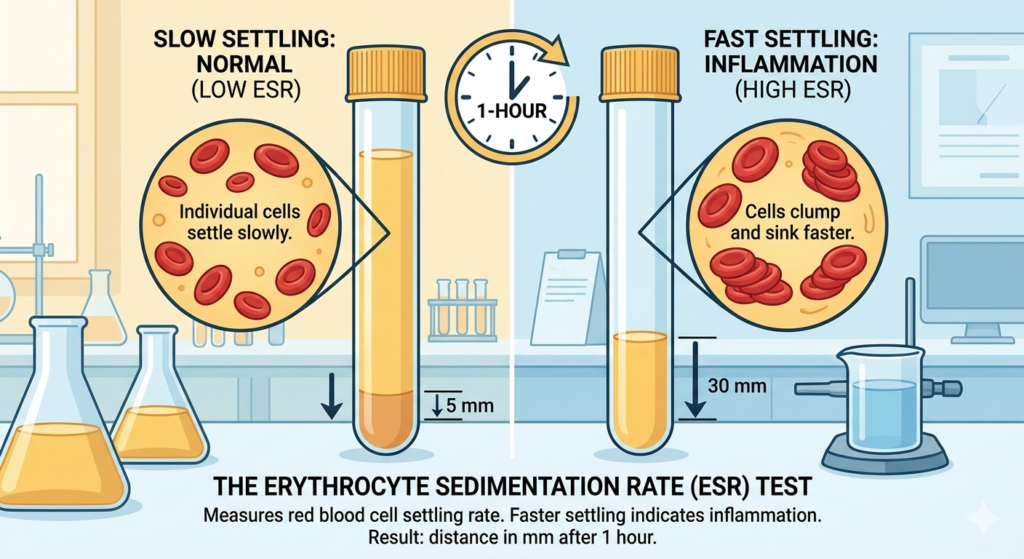
A high ESR does not diagnose a specific disease on its own. It is a nonspecific test, meaning it gives a clue that inflammation may be present but does not identify the exact cause. Doctors may use it alongside other clinical information and tests when assessing infections, autoimmune conditions, cancers and other inflammatory disorders.
Although newer tests such as C-reactive protein can provide more specific information in some cases, ESR remains widely used in many resource-limited settings. It is relatively cheap, simple to perform, does not require electricity, and can be done in clinics without advanced laboratory equipment. That is why it still matters in Ghana.
The Ghanaian study: one tube upright, one tube tilted
The researchers conducted the study at Asuofua Health Centre in Kumasi, in the Ashanti Region of Ghana. They recruited 100 participants: 50 apparently healthy blood donors and 50 pregnant women.
For each participant, blood was collected and prepared in two Westergren tubes. One tube was positioned vertically at 90 degrees, following the standard one-hour Westergren method. The second tube was placed at a 45-degree angle and read every minute for 10 minutes.
The question was simple: could the tilted tube produce a result that closely matched the standard one-hour method?
The answer was promising.
The researchers found that ESR readings taken from the sixth to the tenth minute in the 45-degree tube were comparable to the one-hour readings from the vertical tube. The strongest agreement was seen at the eighth minute.
In practical terms, the study suggests that a test usually read after 60 minutes may be estimated reliably after about eight minutes when the tube is tilted at 45 degrees.
The potential benefit is easy to understand: faster results without expensive new equipment.
What still needs to be tested?
The findings are encouraging, but they should not yet be treated as a final clinical recommendation.
The study was a preliminary method comparison with a modest sample size. The researchers did not deeply assess extreme ESR values or examine all the biological and technical factors that can affect ESR results. These include haematocrit, red blood cell shape, protein concentration, tube type, temperature and operator variability.
This is particularly important in Ghana and across West Africa, where sickle cell disease is a major health concern. Red blood cell shape can affect how cells settle, so future studies should test the method in more diverse patient groups, including people with sickle cell disease, active infections and chronic inflammatory conditions.
Larger validation studies across different hospitals and laboratories would be needed before this novel approach to the blood test could be widely adopted.
A small tilt, a bigger lesson
Even with these caveats, the blood test study is an important example of locally led science solving locally relevant problems.
If future studies confirm these findings, the eight-minute 45-degree ESR method could become a simple, affordable adaptation for clinics in Ghana and similar settings to run the blood test.
For now, the message is simple: Sometimes the smallest shift makes the biggest impact.
About the study:
Amponsah FA and colleagues. Rapid Measurement of Erythrocyte Sedimentation Rate Using a Tube Positioned at a 45° Angle Compared With the Westergren Reference Method. BioMed Research International, 2026. – https://pmc.ncbi.nlm.nih.gov/articles/PMC13280657/